
A hand truck can typically hold between 150 and 1,000 pounds depending on its design. Folding models hold 150 to 300 pounds, standard utility trucks hold 500 to 600 pounds, and heavy duty or convertible carts hold 800 to 1,000 pounds. Always verify your equipment’s manufacturer rating label before loading.
The manufacturer rated capacity printed on the equipment label or owner manual is the only official number that matters. Lightweight folding hand trucks often have ratings between 150 and 300 pounds. Standard utility hand trucks commonly hold 500 to 600 pounds. Heavy duty industrial models, appliance hand trucks, and commercial convertible carts can carry 800 to 1,000 pounds or more under specific setup conditions.
In this guide, you will learn how different hand truck designs determine real working strength, how to locate your exact model rating, why terrain and stairs change your working limits, and how to tell whether your specific load is safe to move.
How Much Weight Can a Hand Truck Carry?
Most hand trucks can carry between 150 pounds and 1,000 pounds, depending on their build, frame, and configuration. Lightweight folding carts often top out around 150 to 300 pounds, standard models handle 500 to 600 pounds, and heavy-duty industrial units can reach 800 to 1,000 pounds or more. Because load limits vary widely, you should always check the manufacturer’s rated capacity for your specific model before moving a load.
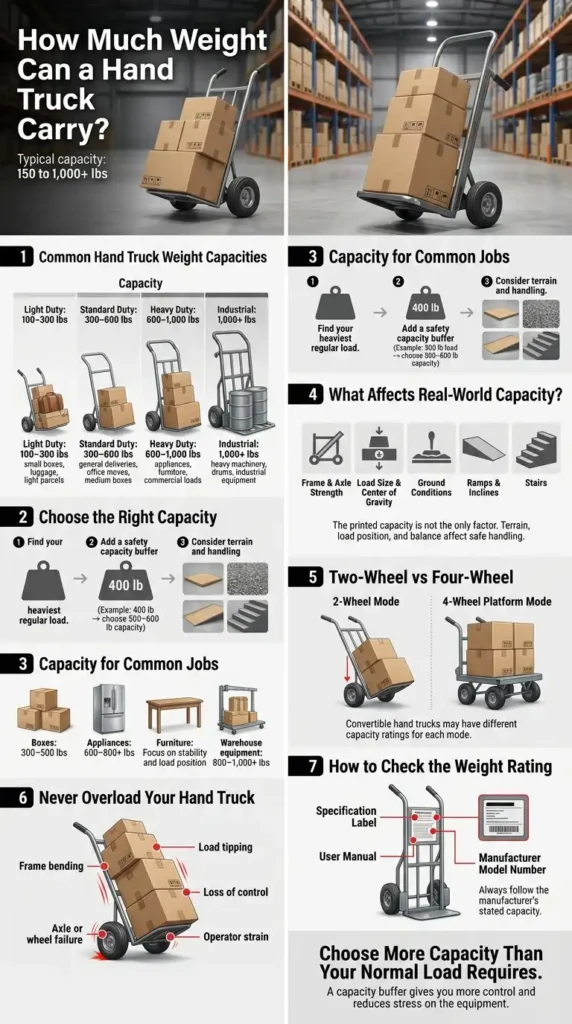
How Much Weight Can a Hand Truck Hold?
A hand truck does not have one universal capacity because manufacturers design different models for completely different tasks. A compact folding cart built for luggage cannot handle the same forces as a commercial steel utility cart built for freight depots.
Lightweight folding models prioritize portability. They fold flat to fit inside a vehicle trunk or closet. To achieve that small size, they use thinner tubing, folding joints, and smaller wheels. That limits their typical load capacity to between 150 and 300 pounds.
Standard utility hand trucks are the classic vertical models seen on delivery routes and rental yards. These units generally have ratings between 400 and 600 pounds. They handle basic moving duties, large cardboard boxes, and household furniture.
Heavy duty commercial trucks and dedicated appliance trucks use thicker structural frames and reinforced nose plates. Their ratings typically reach 600 to 800+ pounds. Certain commercial convertible hand trucks can carry up to 1,000 pounds, but usually only when transformed into a four wheel horizontal platform cart.
Because designs differ so widely, general category ranges only serve as rough guides. The manufacturer’s technical specification for your exact model is always the final authority.
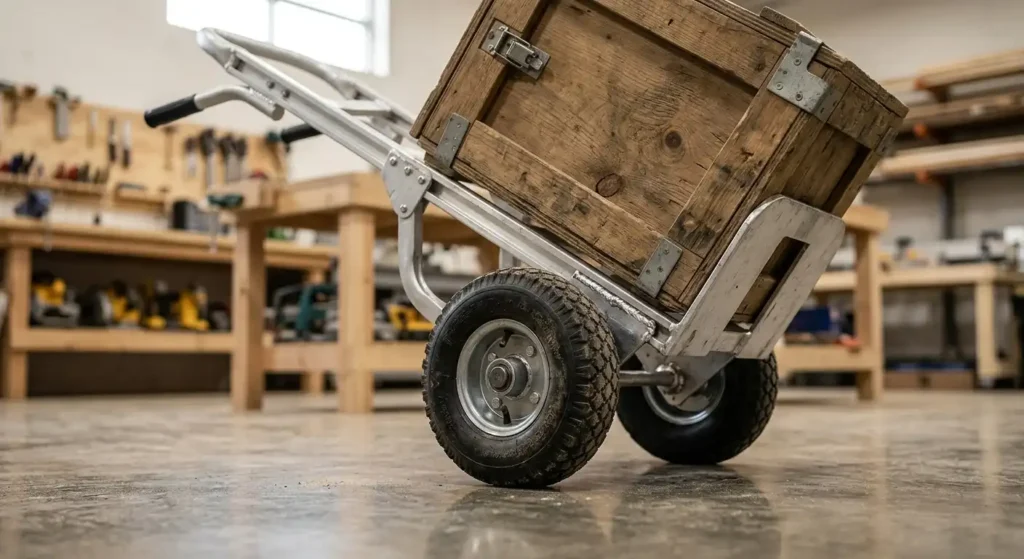
| Hand Truck Category | Typical Capacity Range (Examples) | Common Uses |
| Lightweight Folding | 150 to 300 lbs | Luggage, small boxes, light office supplies |
| Standard Utility | 400 to 600 lbs | Moving boxes, retail inventory, light appliances |
| Heavy-Duty Commercial | 600 to 800+ lbs | Warehouse freight, commercial deliveries |
| Convertible (Upright 2-Wheel) | 500 to 700 lbs | Standard vertical stacking |
| Convertible (Platform 4-Wheel) | 800 to 1,000 lbs | Wide, flat boxes and bulk warehouse items |
| Specialty (Appliance / Industrial) | 800 to 1,200+ lbs | Commercial appliances, machinery, vending units |
Note: Capacities vary significantly by individual model and brand. Always check the official rating stamped on your equipment before loading.
Hand Truck Weight Capacity by Type
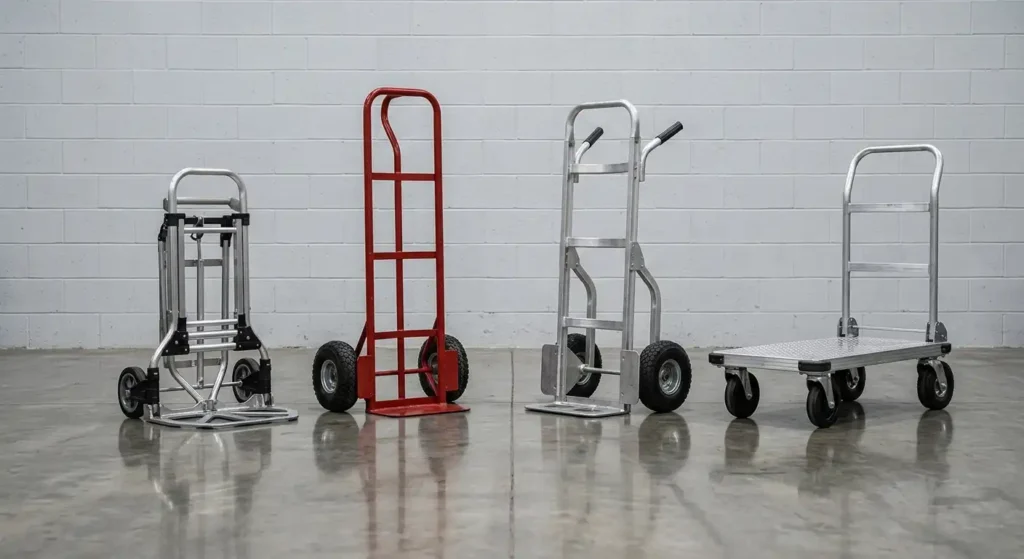
Different types of hand trucks serve specific material handling duties. Because their shapes and features vary, each category tends to operate within a specific weight capacity bracket.
Folding Hand Trucks
Folding hand trucks feature telescoping handles, collapsible frame uprights, and wheels that fold flat against the nose plate. These tools work well for sales reps carrying product samples, travelers moving luggage, or office workers moving paper archive boxes.
Because folding hand trucks rely on hinges, slide pins, and joint locks, their working capacity is inherently lower than rigid frames. Most quality folding models hold between 150 and 300 pounds. Overloading a folding hand truck can warp the telescoping handle tubes, preventing them from extending or retracting smoothly.
Standard Two Wheel Hand Trucks
The standard upright utility hand truck is the workhorse of home moves, shipping bays, and retail backrooms. These units feature a solid vertical frame, two loop or curved handles, two wheels, and a rigid nose plate.
Most basic consumer models found in hardware stores carry ratings from 400 to 600 pounds. Commercial utility versions used by freight drivers feature ratings between 600 and 800 pounds. The operator tilts the load back over the axle, allowing the two wheels to carry the bulk of the weight while the operator balances and steers the load.
Heavy Duty Hand Trucks
Heavy duty models feature thick structural tubing, wide extra welded gussets around the axle mounts, and reinforced cross bars. They are built for rigorous factory environments, construction sites, and freight docks.
These units generally hold between 700 and 1,000 pounds. They often include wheel fenders to prevent wide loads from rubbing against the tires, along with heavier solid rubber or high capacity pneumatic tires mounted on cast metal rims.
Appliance Hand Trucks
Appliance hand trucks handle tall, heavy consumer equipment such as water heaters, washers, and freezers. They usually have capacities between 600 and 800 pounds.
These trucks incorporate dedicated features: built-in manual strap winches to lock the appliance tightly against the frame, rubber padding along the rails to avoid scratching painted enamel, and stair climber belts mounted behind the wheels.
When moving large home appliances, you must balance both the weight rating and the strap placement. For clear steps on setting up this job, read our guide on how to move a refrigerator with a hand truck.
Convertible Hand Trucks
A convertible hand truck transforms between a standard two wheel upright truck and a four wheel horizontal platform cart. It achieves this with a release latch that allows the secondary frame and small swivel casters to fold out.
You must be exceptionally careful with convertible weight ratings:
Important Configuration Rule: Convertible hand trucks almost always feature two separate weight ratings. The vertical two wheel mode typically supports 500 to 600 pounds, while the horizontal four wheel platform mode can support 800 to 1,000 pounds on the exact same frame.
The reason for this split is weight distribution. In four wheel mode, the load sits flat across two fixed wheels and two swivel casters, spreading the downward force across four points on the floor. In two wheel mode, the entire load sits across one axle and two wheels, with the operator holding back part of the tipping weight. Always verify which configuration you are using before loading the platform.
Stair Climbing Hand Trucks
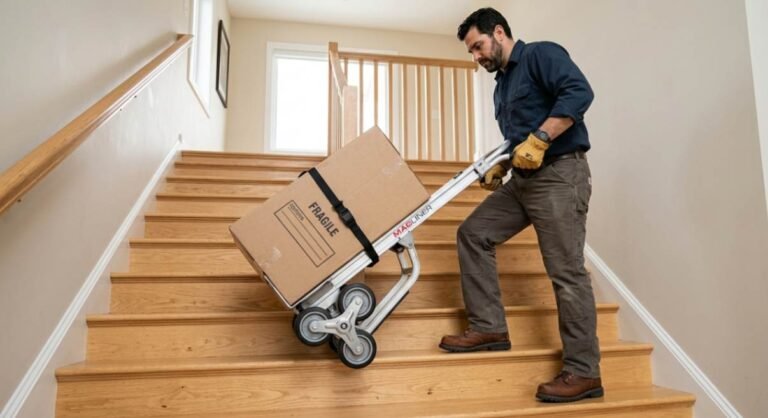
Stair climbing hand trucks feature rotating three wheel star assemblies or continuous rubber stair crawler belts on the frame rear. These additions help the cart roll over stair noses without crashing down on each step.
Most manual stair climbers hold between 300 and 500 pounds. While the physical frame might be capable of taking more static weight, moving on stairs introduces severe dynamic impacts as the load transfers from step to step.
Powered motorized stair climbing hand trucks carry heavier loads, often 600 to 1,000 pounds, using internal drive motors to lift the frame. You should never assume an upright truck can take its full flat ground rating onto a flight of steps. For proper handling techniques on steps, follow our step by step walkthrough on how to use a hand truck on stairs.
How Much Weight Can a Two Wheel Hand Truck Hold?
A standard two wheel hand truck typically holds between 400 and 800 pounds, depending directly on whether it is a light utility model or an industrial delivery cart.
In two wheel operation, balance is everything. The entire load pivots on a single horizontal axle. When you tilt the cart back into moving position, the axle acts as the fulcrum. If the load is packed correctly against the frame, the wheels bear nearly ninety percent of the downward force, leaving only ten to twenty percent of the balance weight in your hands.
If the cart is overloaded, tilting the machine back past its center of balance requires dangerous physical straining. If you lose control of an 800 pound load on a two wheel truck, the handle will whip upward or slam down to the ground instantly. To evaluate how balance mechanics differ when using additional support wheels, read our guide comparing 2 wheel vs 4 wheel hand trucks.
How Much Weight Can a Four Wheel Hand Truck Hold?
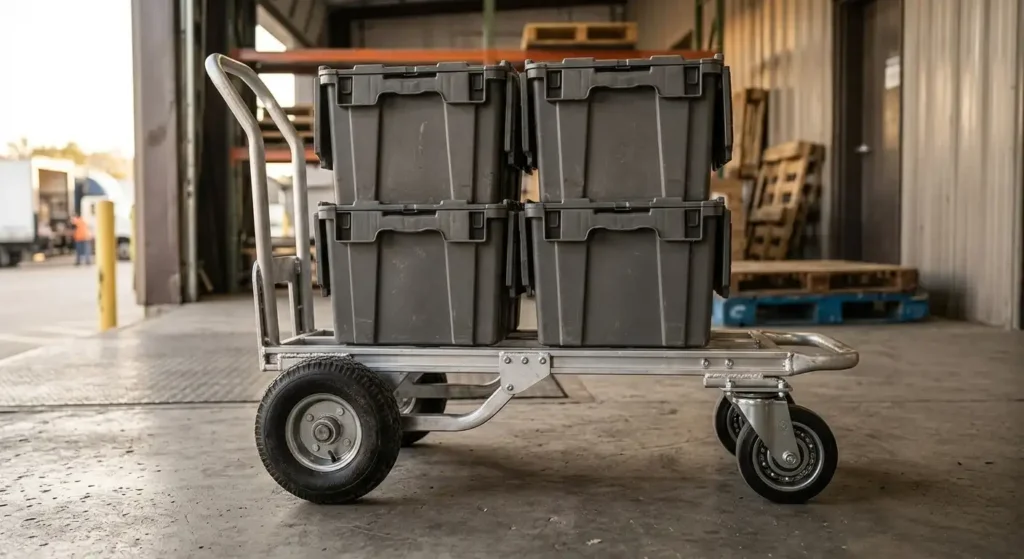
Four wheel hand trucks, platform trucks, and convertible hand trucks in their horizontal cart position generally hold between 800 and 1,200 pounds. Commercial industrial platform carts can hold several thousand pounds when equipped with heavy structural steel frames and thick polyurethane casters.
The four wheel design changes how weight moves. The operator does not balance the cargo. Gravity pulls the load straight down through four contact points on the floor. Because you do not have to hold up the tilt weight, you can move heavier assemblies with less physical fatigue on level ground.
Do not assume that every cart with four wheels is automatically high capacity. A light office utility cart with four small rubber wheels might carry only 250 pounds, while an industrial convertible aluminum delivery truck carrying cargo on four heavy duty casters can support 1,000 pounds.
How to Check the Weight Capacity of Your Hand Truck?
Never guess how much weight your hand truck can carry. Follow this simple six step process to verify the official rating before loading your cart.
- Find the capacity decal or metal plate: Most reputable manufacturers place a permanent silver foil sticker, stamped plate, or warning label on the rear side of the main upright frame tubes or directly across the back of the bottom cross member.
- Locate the exact model number: If the decal has peeled away or become unreadable from use, look for an engraved or stamped model number on the frame or axle housing.
- Check the manufacturer documentation: Search the exact model number on the official manufacturer website to view the original engineering cut sheet or user manual.
- Confirm your operating configuration: If you have a convertible truck, look at the two separate numbers listed in the manual. Confirm which rating applies to vertical two wheel use versus horizontal four wheel use.
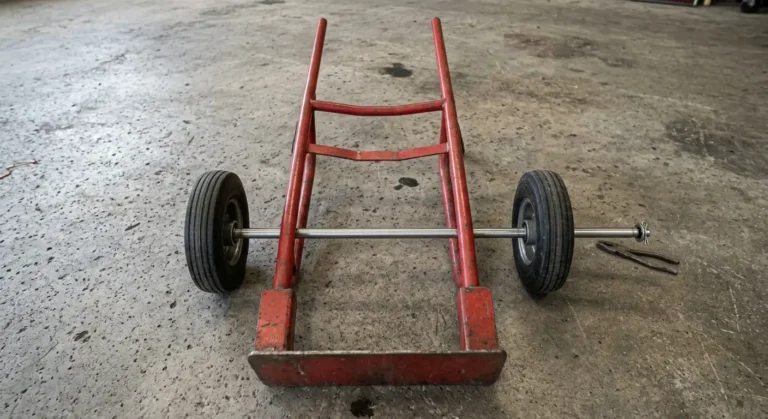
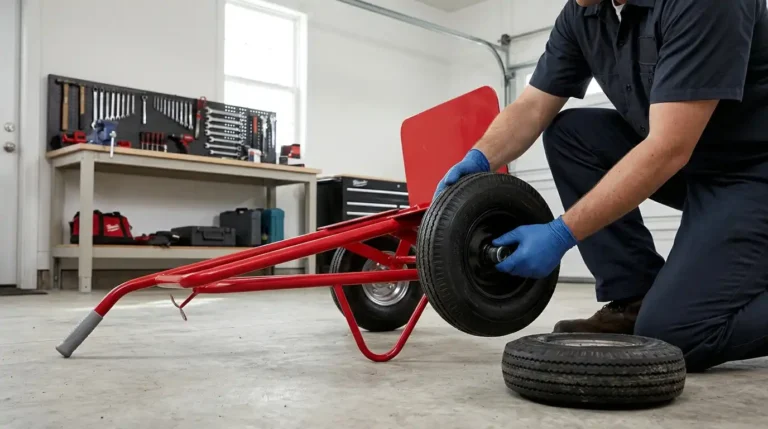
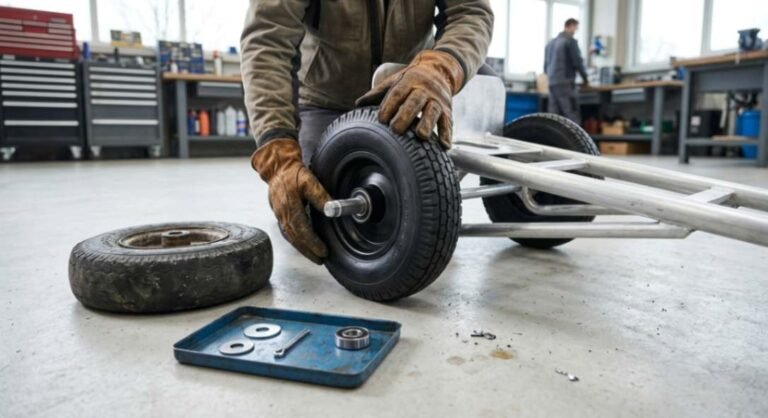
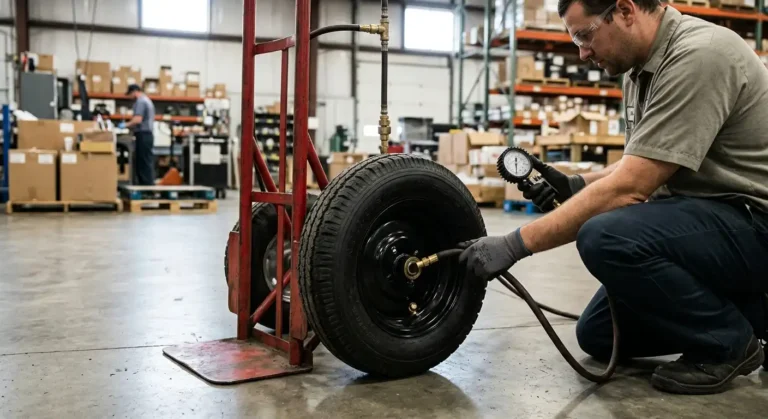
- Inspect the wheels: Look at the tire sidewalls. If someone previously replaced the original factory wheels with cheap aftermarket replacements, those replacement tires or plastic hubs may have a much lower capacity than the steel frame itself. The lowest rated component determines your true safe capacity limit.
- Check for frame damage: Inspect the metal around the axle brackets, the nose plate welds, and the handle joints. A cracked weld, bent crossbar, or bowed axle cuts your practical working capacity well below the original printed rating.
Does the Weight Capacity Change on Stairs?
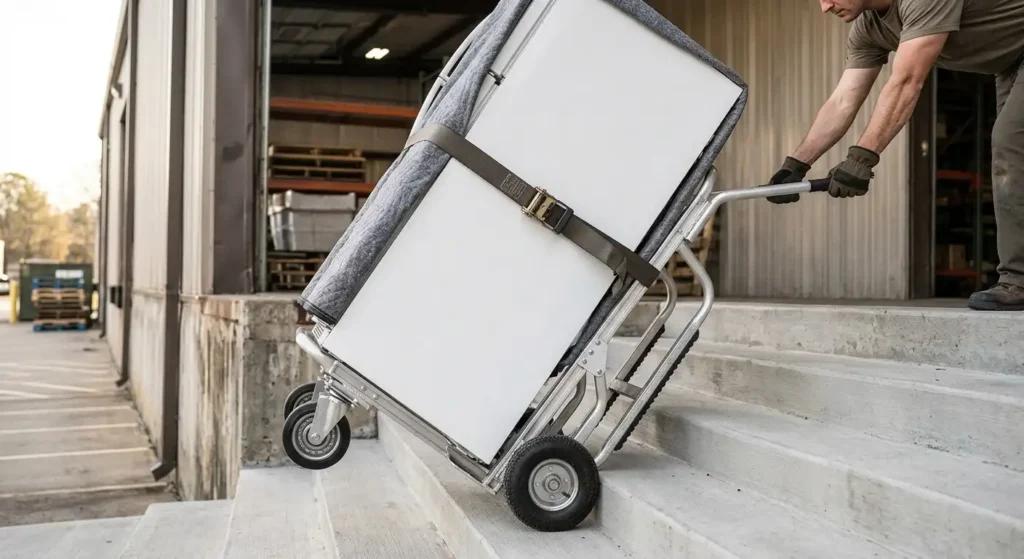
A hand truck’s standard weight capacity does not automatically apply to stairs. Unless the manufacturer explicitly certifies a specific weight rating for stair operations, you should assume your safe working capacity on stairs is substantially lower than on flat, level ground.
When you pull a loaded hand truck up a flight of stairs, several physical forces change at once:
- Dynamic shock loading: As the wheels hit each step edge, the cart drops and bounces slightly. This shock multiplies the downward force on the frame, axle, and wheel bearings compared to rolling smoothly on concrete.
- Extreme operator strain: On flat ground, the wheels support almost the entire load. On stairs, the operator must hold back a huge percentage of the falling weight while pulling upward against gravity.
- Loss of balance: Any slight slip on a stair tread shifts the entire load instantly to one wheel, threatening to roll the equipment off the edge.
If a hand truck is rated for 600 pounds on flat ground, trying to take 600 pounds down a flight of residential steps with two wheels is extremely dangerous. Without specialized stair belts, a three wheel climbing cluster, or a powered stair climbing system, standard hand trucks should only carry modest, easily controlled loads on stairs.
How to Safely Move a Heavy Load With a Hand Truck?
Moving a heavy load safely requires deliberate setup, careful loading technique, and steady execution.
Start by confirming that the combined weight of your cargo sits comfortably below the manufacturer’s rated capacity. Inspect your hand truck before loading. Make sure pneumatic tires have equal air pressure, wheel nuts are tight, and the frame shows no bends or cracks.
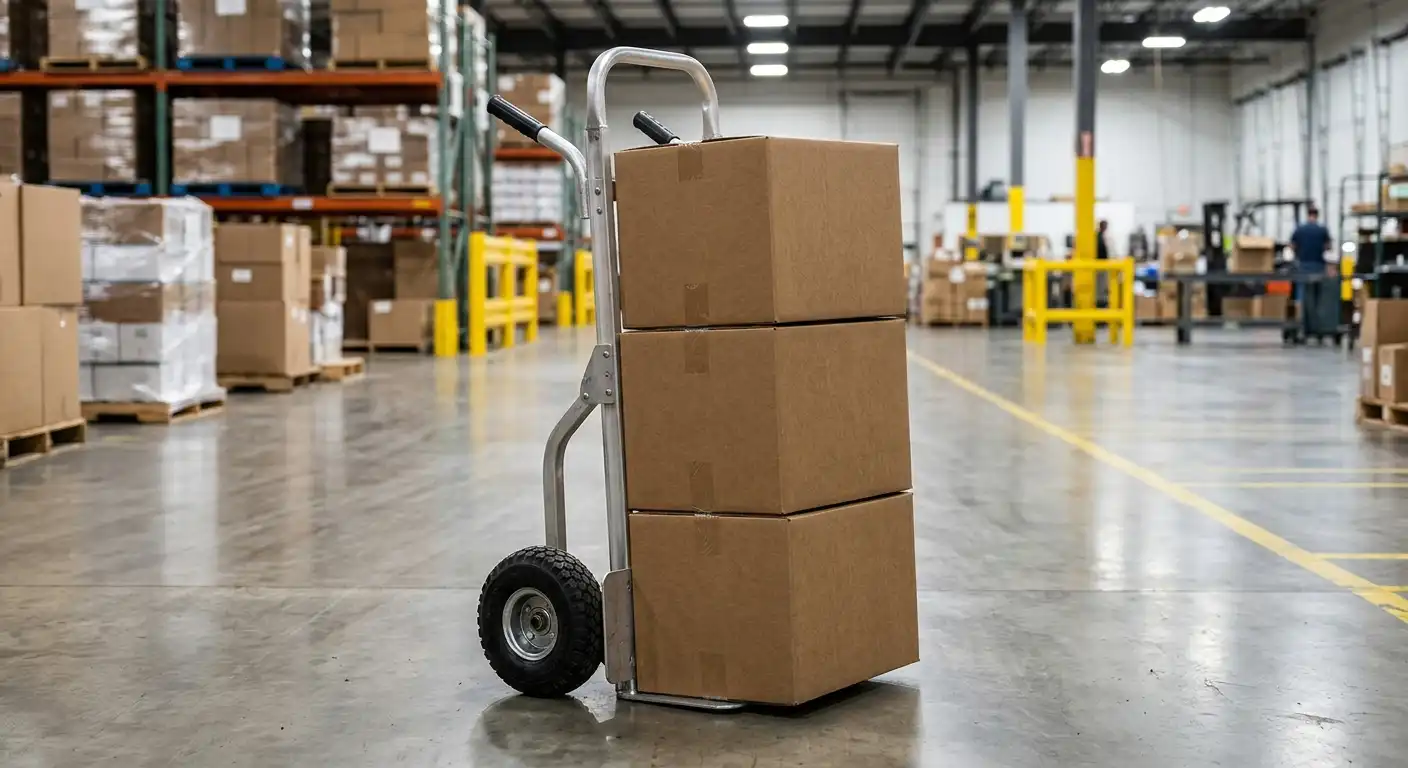
When loading, slide the nose plate completely under the bottom of the cargo until the item touches the back vertical frame rails. Never let cargo rest solely on the front tip of the nose plate. If you are stacking multiple boxes, always stack the heaviest, densest boxes directly on the bottom, with lighter items on top. This keeps the center of gravity as low as possible.
Center the cargo side to side. An off center load pulls heavily to one side, twisting your wrists and making turning difficult. For tall items, appliances, or bulky crates, wrap heavy duty ratchet straps or cam straps around the load and secure them tightly to the cart frame.
Before moving, walk your intended route. Open doors, clear away loose extension cords, and check for floor level changes. When tipping the loaded cart back, place your foot securely against the axle or heel bar, bend your knees, hold both handles firmly, and pull back with your body weight rather than wrenching with your lower back.
Maintain a slow, steady walking pace. Never run with a loaded hand truck, and never let a heavy load roll ahead of you down an incline.
How to Choose the Right Hand Truck Weight Capacity?
Choosing the right capacity involves matching your equipment to your typical loads, your moving environment, and your physical needs. Follow these five evaluation steps.
- Identify your heaviest common item: Determine the maximum weight you plan to move on a regular basis. If your heaviest items are 70 pound shipping cartons, a 300 to 400 pound cart is plenty. If you regularly move 400 pound cast iron shop tools, look for a 700 to 800 pound commercial truck.
- Add a twenty percent safety buffer: Never buy a hand truck whose maximum capacity exactly matches your heaviest load. Choosing a model rated twenty to thirty percent above your heaviest item ensures the cart operates well within its mechanical comfort zone and lasts longer.
- Assess item dimensions and height: A cart needs more than just a weight rating; it needs a frame tall enough to support the item. Tall water heaters and refrigerators require high back frames and integrated tie downs, regardless of whether the weight is 200 or 500 pounds.
- Evaluate your travel surfaces: If you must cross soft grass, cracked asphalt, gravel, or job site debris, choose a model with large pneumatic or flat free solid rubber tires that can carry weight over rough ground without getting stuck.
- Factor in stairs and grade changes: If your route includes regular flights of stairs, prioritize purpose built stair climbing trucks with track climbers or rotating wheels over standard two wheel utility models.
Frequently Asked Questions
Most hand trucks hold between 150 and 1,000 pounds. Compact folding models usually support 150 to 300 pounds. Standard utility hand trucks carry 500 to 600 pounds. Heavy duty industrial models and commercial convertible carts can support 800 to 1,000 pounds or more in specific configurations. Always verify your specific model’s printed rating.
Yes, many standard utility hand trucks and commercial delivery models are rated for 500 pounds or more. However, lightweight consumer folding carts and budget models are often rated for only 150 to 300 pounds. You must check the manufacturer specification label on your exact cart before attempting to move 500 pounds.
Some specialized heavy duty industrial hand trucks and commercial convertible models can carry 1,000 pounds. On convertible models, this 1,000 pound rating almost always applies only when the unit is folded down into its four wheel horizontal platform cart mode. Two wheel upright modes are typically rated for less.
Not necessarily. While steel is very strong and resilient, modern high grade extruded aluminum hand trucks can match or exceed the capacity ratings of basic steel carts. High end commercial aluminum trucks often hold 500 to 800 pounds while weighing much less than comparable steel models.
A dedicated heavy duty appliance hand truck rated for at least 600 to 800 pounds is best for large appliances. These units feature integrated strap winches to hold the machine tight against the frame, protective rubber or vinyl padding to prevent scratches, and rear stair glide belts.