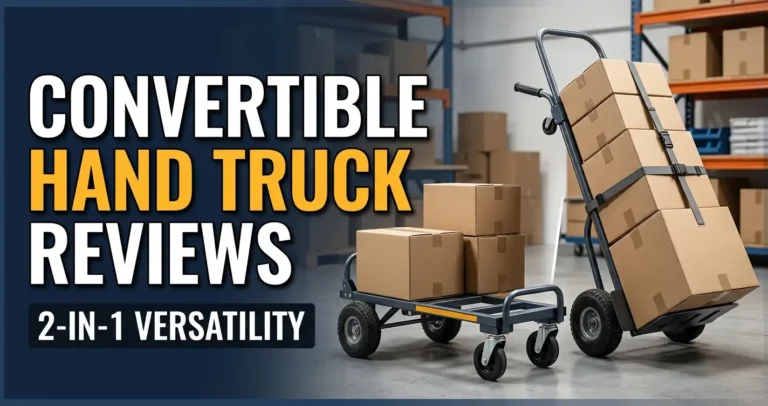

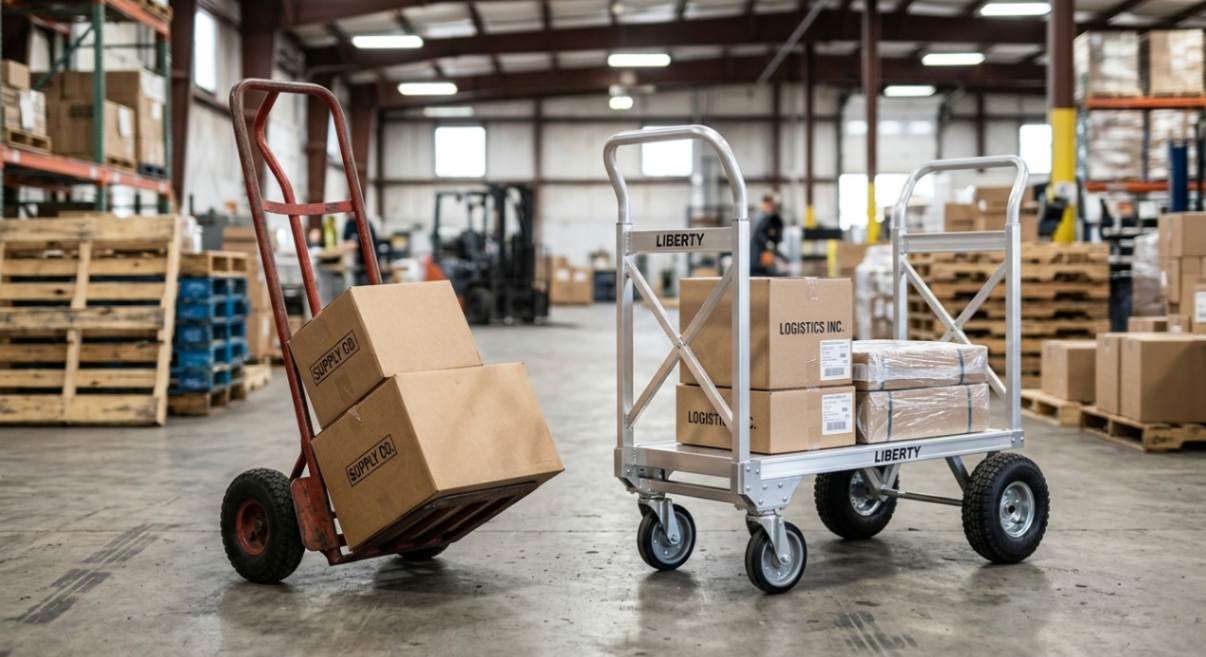
When comparing 2 wheel vs 4 wheel hand trucks, the main difference comes down to how each tool supports and moves a load. A 2 wheel hand truck uses a vertical frame and two main wheels, requiring you to tilt the frame backward to balance and pull the weight. A 4 wheel hand truck uses four contact points on the ground, carrying the entire load flat or upright without requiring you to balance it while rolling.
Neither design is universally better. A two wheel hand truck is usually best if you need to turn tightly, pass through narrow doorways, or go up and down steps. A four wheel hand truck is typically better if you need to roll heavy, bulky, or stacked boxes across long, flat floors.
Choosing the right hand truck depends on your specific work environment, the shape of your cargo, and whether stairs are involved.
2 Wheel vs 4 Wheel Hand Trucks at a Glance
| Feature | 2 Wheel Hand Truck | 4 Wheel Hand Truck |
| Maneuverability | High; pivots easily on a tight axis | Moderate; requires wider turning clearance |
| Stability | Depends entirely on user balance | High; load weight rests on four wheels |
| Tight Spaces | Excellent for narrow halls and doors | Can be clumsy in cramped areas |
| Stairs | Practical; some models built specifically for stairs | Unsuitable for steps and curbs |
| Heavy Loads | Effective, but user supports part of the tilt weight | Effective; the frame bears the entire weight |
| Storage | Compact; stores flat against a wall | Requires a larger footprint on the floor |
| Warehouse Use | Great for quick single-item picks | Ideal for long runs and multi-box orders |
| Uneven Surfaces | Good when equipped with large pneumatic wheels | Smaller casters can get caught on cracks |
| Best Use | Appliances, tight deliveries, stairs, moving boxes | Long horizontal transport on smooth, flat floors |
What Is a 2 Wheel Hand Truck?
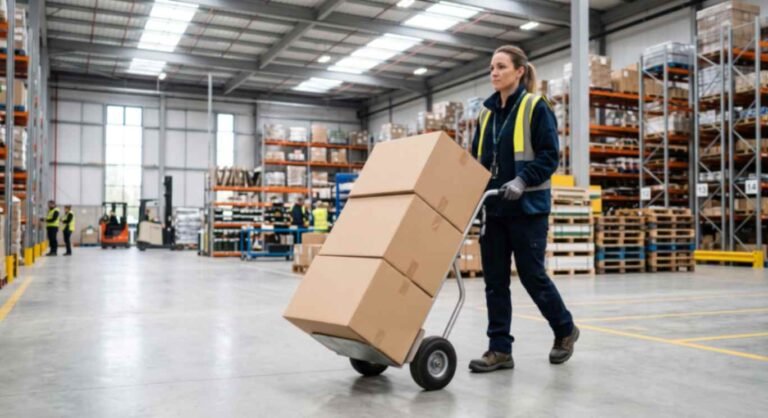
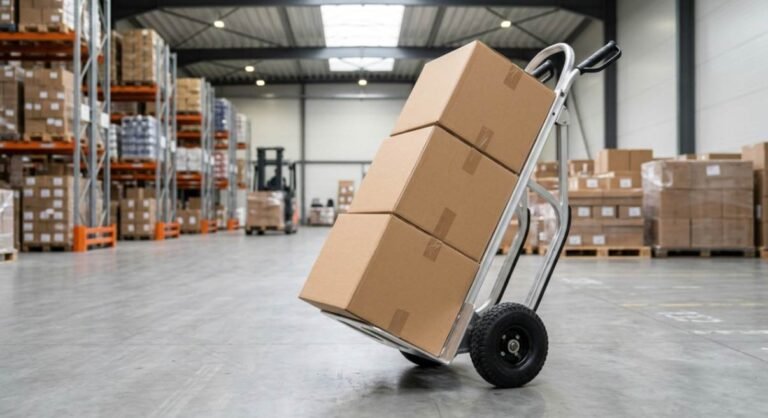
A 2 wheel hand truck (often called a standard hand truck or upright utility dolly) consists of a vertical metal frame, two handles at the top, a flat horizontal toe plate (or nose plate) at the base, and an axle with two wheels.
To operate it, you slide the toe plate under the bottom of an item, place your foot near the axle, and pull the handles back toward your body. This action levers the cargo off the floor and shifts the center of gravity over the two wheels. Because the user provides the counterweight to keep the cargo balanced, physical effort and correct posture are required during transit.
You will see two wheel models used across residential moving, route deliveries, and commercial loading docks. They excel at moving:
- Refrigerators, washing machines, and other large appliances
- Upright furniture pieces like dressers and bookcases
- Heavy individual cartons and stacked parcels
- Household moving boxes
- Steps and thresholds (when using an appropriate hand truck for stairs)
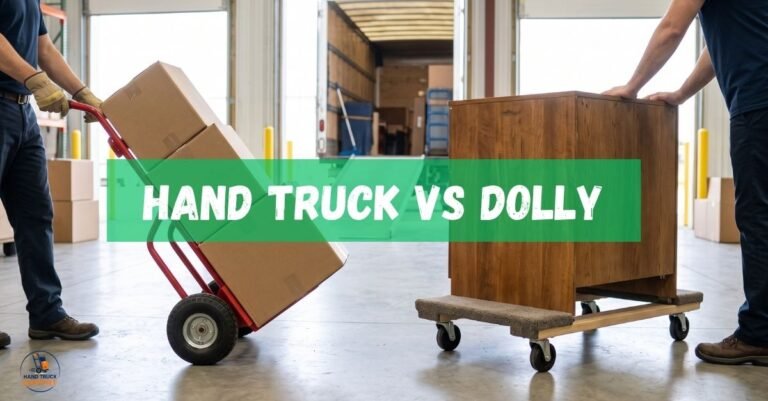
The primary advantage of a two wheel hand truck is maneuverability. It allows you to pivot on the spot, squeeze through standard residential doorways, and tip heavy items back safely with minimal ground contact. You can also read our expert guides on hand truck vs dolly.
What Is a 4 Wheel Hand Truck?
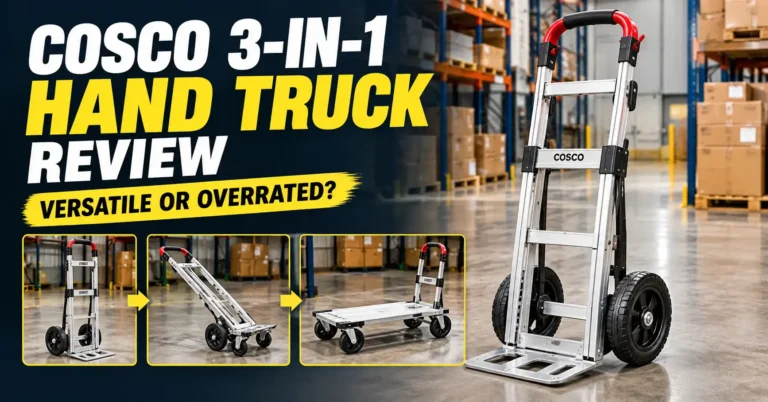
A 4 wheel hand truck uses four wheels distributed across its base to support the full weight of a load on the ground. These trucks generally fall into two categories: dedicated platform carts (flatbeds) or multi-position convertible hand trucks
that can switch between an upright two wheel mode and a horizontal four wheel mode.
On a four wheel unit, two wheels are usually fixed while the other two are swivel casters that allow you to steer. Because all four wheels stay in contact with the ground, you push or pull the cart without having to tilt the load back or balance its weight in your hands.
Typical applications include:
- Moving large stacks of uniform boxes across a warehouse
- Transporting long or wide items that would tip over on two wheels
- Moving goods through retail stockrooms and wide loading docks
- Hospital, school, and office mailroom distribution
Four wheel configurations keep loads stable and flat, reducing physical strain on your back, arms, and shoulders during long-distance pushes across smooth concrete or asphalt.
2 Wheel vs 4 Wheel Hand Trucks: Key Differences
To pick the right tool, you need to understand how each design behaves during real-world use.
Maneuverability
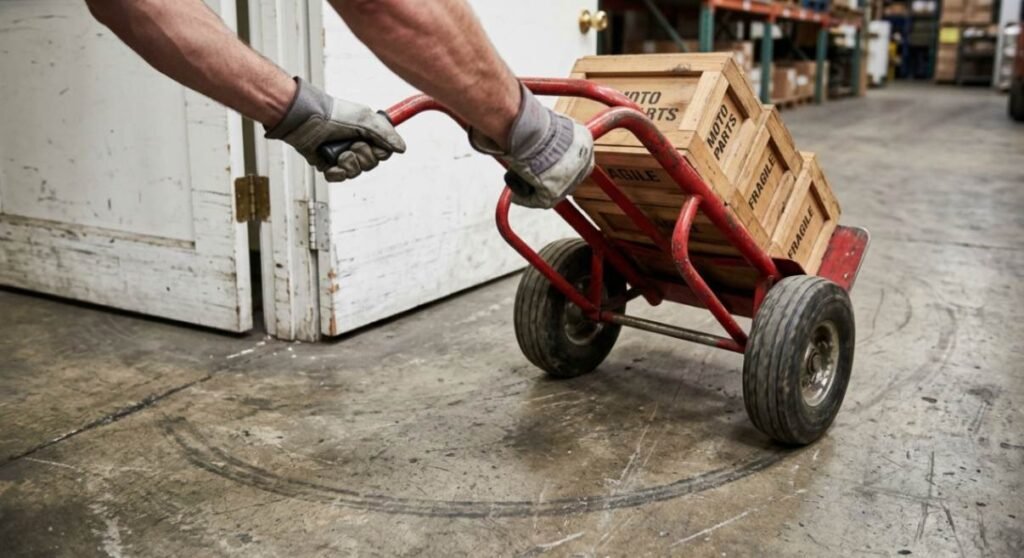
A 2 wheel hand truck turns on its own axle. You can stop, spin 180 degrees in place, and back through a narrow doorway or around a sharp corner. This makes it the clear choice for residential hallways, crowded retail aisles, and truck-to-door delivery routes.
A 4 wheel hand truck has a longer wheelbase and a wider turning radius. While the swivel casters make it easy to push forward and guide around gradual curves, turning sharply in a small room or narrow corridor can be awkward and slow.
Stability
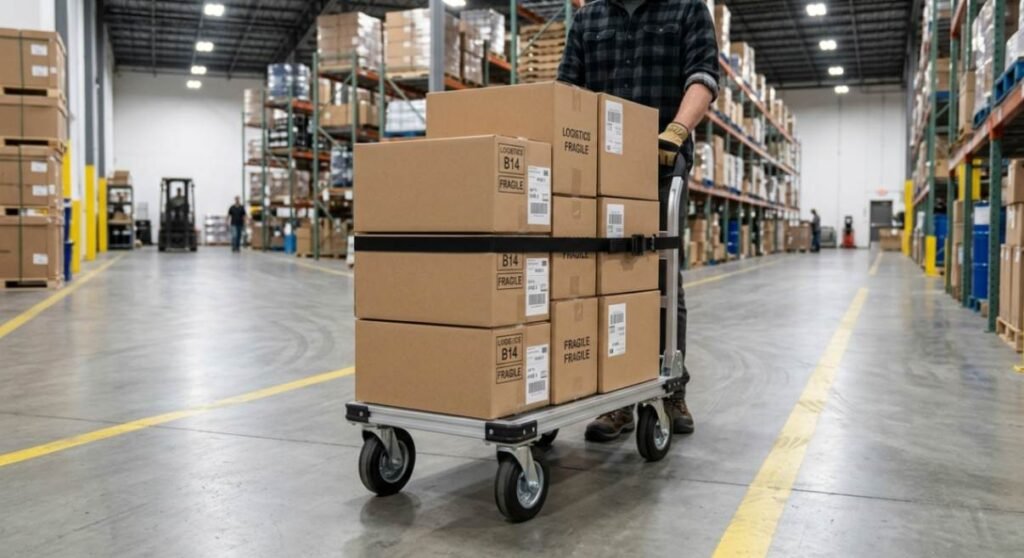
A 4 wheel model provides four points of contact with the floor. As long as your load is stacked neatly and the ground is level, the truck remains upright and stable on its own.
With a two wheel model, stability depends heavily on the operator. If you hit a small pebble, tilt the frame too far back, or allow a top-heavy item to shift sideways, you must use your own muscle power to keep the truck from falling over.
Heavy Loads
When shopping for a hand truck for heavy loads, do not look only at the weight rating. A two wheel hand truck and a four wheel hand truck might both be rated for 800 pounds, but handling that weight feels completely different on each.
On a 4 wheel truck, the structural frame and casters bear the entire 800 pounds. Your job is simply to push the cart forward. On a 2 wheel truck, you have to break back that 800-pound load using leverage, and your arms and core must constantly stabilize a portion of that weight while rolling.
For dense, compact items like a water heater, a high-capacity two wheel frame works well. For five stacked crates of heavy parts, a four wheel cart is far easier to manage.
Stairs
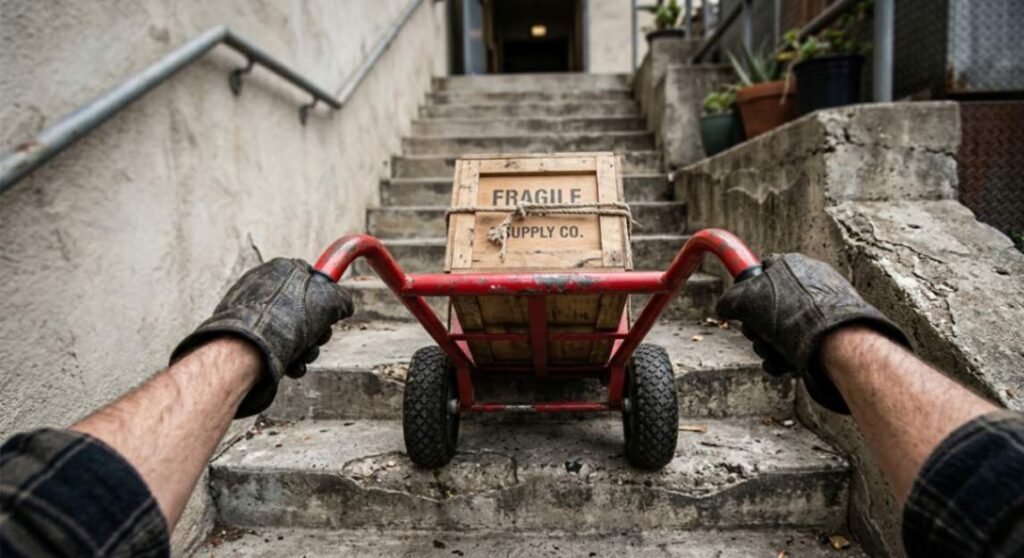
For moving items over steps or curbs, a 2 wheel design is the only practical choice among standard options. You can roll the two main wheels up over each stair tread or ease them down one step at a time. Many delivery models feature built-in stair glides on the back of the frame to slide smoothly over step edges.
Standard 4 wheel hand trucks cannot be used on stairs. Their long frames, fixed lower clearance, and caster arrangements make them unsafe and impossible to roll over steps.
Tight Spaces
In tight spaces like elevators, residential utility rooms, small storage closets, and truck beds, space is limited. A 2 wheel hand truck has a compact vertical footprint, letting you stand right behind the load and maneuver in inches of clearance. A 4 wheel platform truck takes up significant floor space and can easily get boxed in if an area is crowded.
Uneven Outdoor Surfaces
Moving across gravel, cracked concrete, dirt paths, or grass requires adequate ground clearance and wide wheels.
A 2 wheel hand truck equipped with large pneumatic tires rolls over rough terrain easily because the user can adjust the tilt angle to clear obstacles. A 4 wheel hand truck often struggles on uneven outdoor ground. If the small swivel casters drop into a crack or sink into soft soil, the entire cart can stop dead, potentially spilling the cargo.
Loading and Unloading
Loading a 2 wheel hand truck requires sliding the thin toe plate directly under the cargo at floor level. This is quick and efficient for individual items like cartons, crates, and large appliances.
Loading a 4 wheel platform truck usually means lifting the item several inches off the ground to set it onto the deck. While this takes slightly more initial effort per item, the wide deck lets you stack multiple items side by side without worrying that they will tip over while you load the rest.
Pros and Cons of 2 Wheel Hand Trucks
Pros
- Superior maneuverability: Turns in place and easily navigates narrow spaces.
- Compact footprint: Fits in small storage spaces, car trunks, and crowded elevators.
- Stair capable: Can be pulled up steps or lowered down curbs.
- Fast loading: Slips directly under boxes and appliances with minimal manual lifting.
- Great for single bulky items: Excellent control for tall furniture and machinery.
Cons
- Requires constant balance: Operator must support a portion of the load weight.
- Limited deck capacity: Cannot carry wide, spread-out loads easily.
- Fatigue on long runs: Carrying heavy loads over long distances causes more physical strain.
Pros and Cons of 4 Wheel Hand Trucks
Pros
- Full weight support: Wheels bear 100 percent of the cargo weight on level ground.
- High volume capacity: Carries multiple stacked boxes or wide parcels at once.
- Reduced user fatigue: Pushing a rolling platform takes minimal core and arm effort.
- Stable platform: Cargo stays flat and upright without continuous balancing.
Cons
- Poor stair mobility: Cannot be used on stairs or tall curbs.
- Wider turning radius: Harder to maneuver through narrow doors and tight corners.
- Caster sensitivity: Small front or rear casters can snag on rough surfaces, cracks, or debris.
- Storage footprint: Takes up more floor space when not in use.
Which One Should You Choose?
Use these clear scenarios to determine which tool matches your day-to-day work:
Choose a 2 wheel hand truck if:
- You regularly encounter stairs, steps, or street curbs.
- You need to move appliances, dressers, or tall individual items.
- You work in residential homes, apartments, or small offices with narrow hallways.
- You need a compact tool that can hang on a garage wall or ride in a delivery van.
- You are making fast, individual package drops.
Choose a 4 wheel hand truck if:
- You work primarily inside a warehouse, stockroom, or large facility with smooth, level concrete floors.
- You need to move multiple boxes, bins, or supplies in a single trip.
- You want to reduce physical strain when moving heavy loads over long horizontal distances.
- You transport wide, flat items that would hang awkwardly off a standard nose plate.
Get a convertible hand truck if:
- Your daily tasks involve both route deliveries (using 2 wheels) and warehouse restocking (using 4 wheels).
- You want the flexibility of both styles without buying and storing two separate tools.
- Note that convertible models are heavier and contain more moving joints, which can require more maintenance over time.
Weight Capacity Is Not Everything
A common mistake buyers make is picking a hand truck based strictly on its rated maximum load capacity. While capacity is important, it does not guarantee that a load will be easy to move.
When evaluating a hand truck, also consider:
- Toe plate depth and width: A small toe plate will not safely support deep boxes or bulky furniture.
- Center of gravity: Tall, top-heavy items place more leverage against your arms on a two wheel truck.
- Frame material: Aluminum frames are lightweight and easy to lift in and out of trucks, while steel frames provide maximum rigidity for harsh industrial use (see our guide on aluminum vs steel hand trucks).
- Handle style: Dual handles give you precision control for tipping, while a continuous loop handle lets you push with one or two hands at various heights.
A properly balanced 300-pound load on a well-designed frame is much easier to manage than a 200-pound awkward load on a truck with the wrong dimensions.
Wheel Type Matters Too
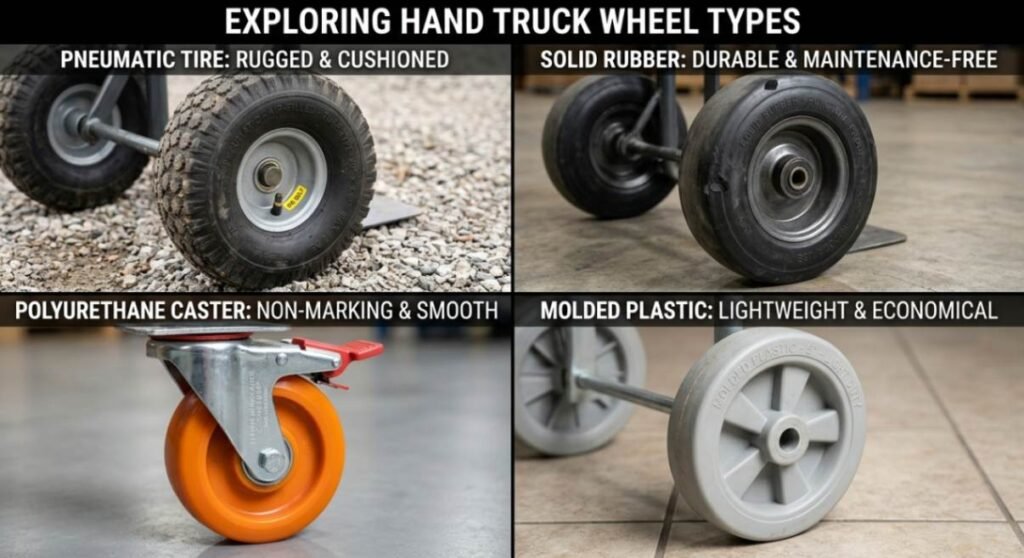
The number of wheels is only half the equation; the wheel material and diameter dictate how the truck rolls on different surfaces.
- Pneumatic tires (air-filled): Absorb bumps, roll over gravel and grass smoothly, and cushion delicate loads. They require periodic air pressure checks and can go flat.
- Solid rubber tires: Puncture-proof and maintenance-free. They roll well on rough surfaces but are heavier than air-filled wheels.
- Polyurethane wheels: Extremely durable, chemical-resistant, and non-marking. Excellent for indoor commercial and industrial floors.
- Thermoplastic casters: Standard on many four wheel platform carts. They roll smoothly on clean concrete and linoleum but struggle against door thresholds, wood chips, and floor debris.
For outdoor use, look for larger wheel diameters (10 inches or larger) on a two wheel frame. For indoor warehouse use, hard rubber or polyurethane wheels on a four wheel base will roll with the least resistance.
2 Wheel vs 4 Wheel Hand Trucks: Which Is Better?
There is no single winner in the 2 wheel vs 4 wheel hand truck debate because each tool solves a different material handling problem.
If your daily work involves tight doorways, stairs, mixed indoor-outdoor terrain, or moving appliances and furniture, a 2 wheel hand truck is the more versatile, practical choice. It gives you the mechanical leverage needed to pivot on a dime and overcome physical barriers.
If your work is centered on flat, level surfaces like warehouses, retail stockrooms, or large workshops where you need to move multiple boxes or heavy supplies over long distances, a 4 wheel hand truck is the better option. It removes the burden of balancing weight, protecting your body from unnecessary strain.
Base your final purchase on the terrain you cross every day and the specific shapes of the items you need to carry.
Frequently Asked Questions
Neither is universally better. A 2 wheel hand truck is better for stairs, tight hallways, and single bulky items like appliances. A 4 wheel hand truck is better for moving multiple stacked boxes across long, flat, level floors without having to balance the load yourself.
On flat, smooth floors, yes. Because the frame and four wheels support all the cargo weight, you do not have to tilt the load or balance it with your arms. You simply push the cart forward, which causes less physical fatigue over long distances.
No. Standard four wheel hand trucks and platform carts cannot safely climb or descend stairs. Their frame layout, low clearance, and caster design make them unsafe for steps. For stair work, use an upright two wheel hand truck built with stair glides or stair-climbing wheels.
A heavy-duty 2 wheel hand truck is usually best for appliances like refrigerators and washers. It allows you to slip the toe plate under the machine, secure it with a strap, and tilt the unit back onto two large wheels to steer through doorways and down steps.
You should buy a convertible hand truck if you regularly switch between delivering single large items through tight doorways and transporting multiple boxes across flat warehouse floors. If all your work happens on one type of terrain, a dedicated two wheel or four wheel unit is usually lighter and more rigid.