
A manual two-wheel hand truck is one of the most common tools for moving heavy boxes, crates, and equipment. Using one correctly reduces physical strain and helps prevent dropped loads, property damage, and workplace injuries.
Operating a hand truck safely requires more than just loading items and tilting the frame back. You need to inspect your equipment, load materials properly, choose the right route, and maintain full control over the cart. This guide covers the essential steps for safe hand truck operation, practical handling techniques, and common mistakes to avoid.
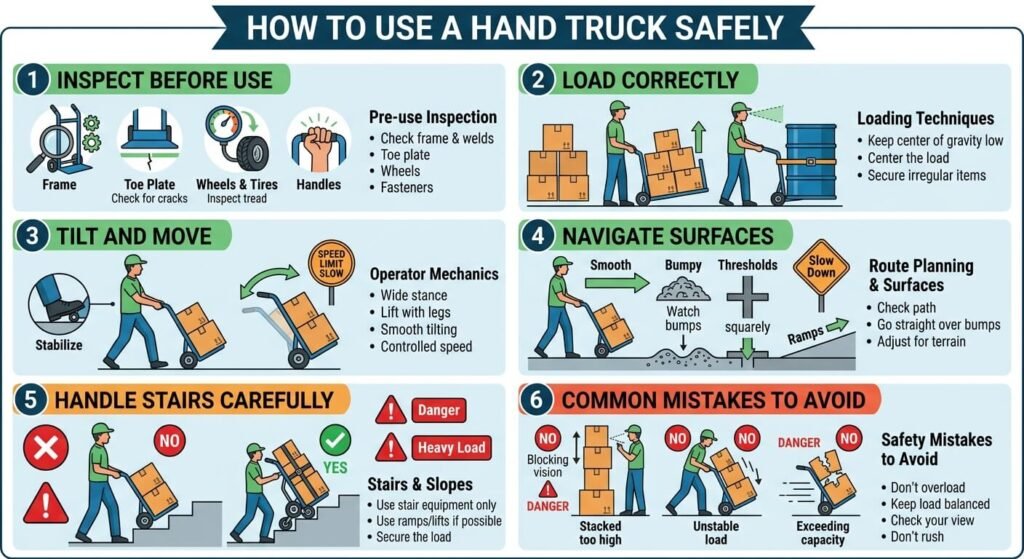
Inspect the Hand Truck Before Using It
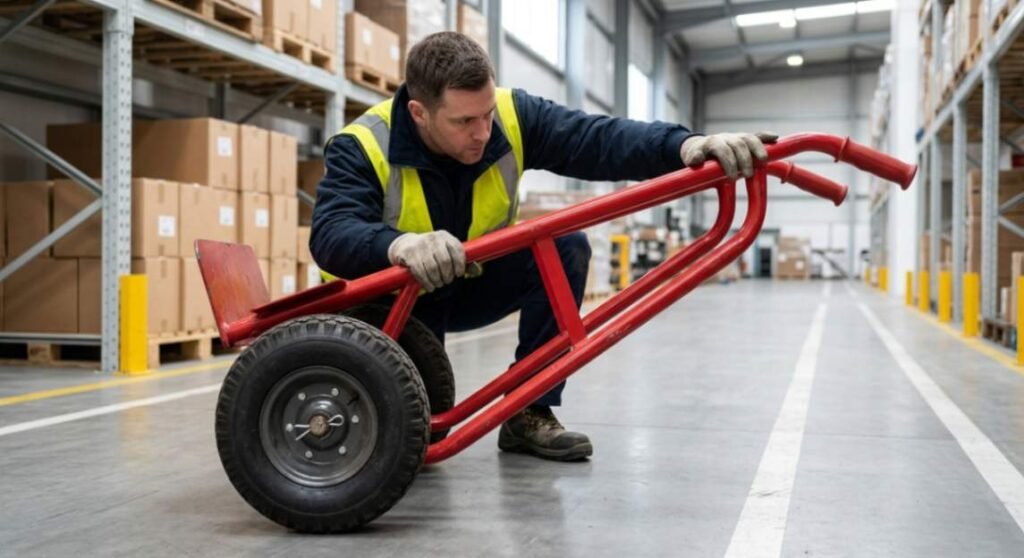
A quick visual and mechanical inspection ensures the hand truck is safe to operate before you place any weight on it. Equipment that is bent, cracked, or worn can fail under a heavy load.
Check these key components before every use:
- Frame and welds: Look for bent uprights, cracked tubing, or damaged crossbars.
- Toe plate (nose): Ensure the plate is straight, firmly attached to the frame, and free of stress cracks.
- Handles and grips: Confirm that the handle grips are secure, clean, and not loose or torn.
- Axle and fasteners: Verify that pins, bolts, and axle retainers are tight and intact.
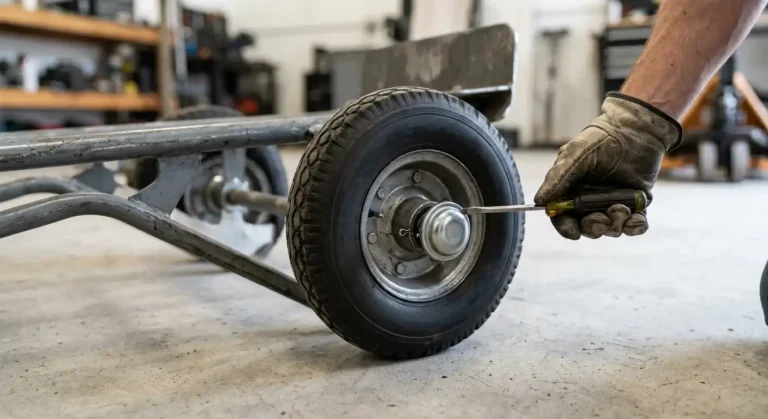
- Wheels and tires: Check for flat spots, worn bearings, cracked hubs, and loose wheels.
- Pneumatic tire pressure: If your hand truck uses air-filled tires, confirm they are inflated to the manufacturer’s recommended PSI. Underinflated tires make heavy loads significantly harder to push and balance.
- Capacity label: Check the manufacturer’s data plate or label to verify the maximum rated capacity.
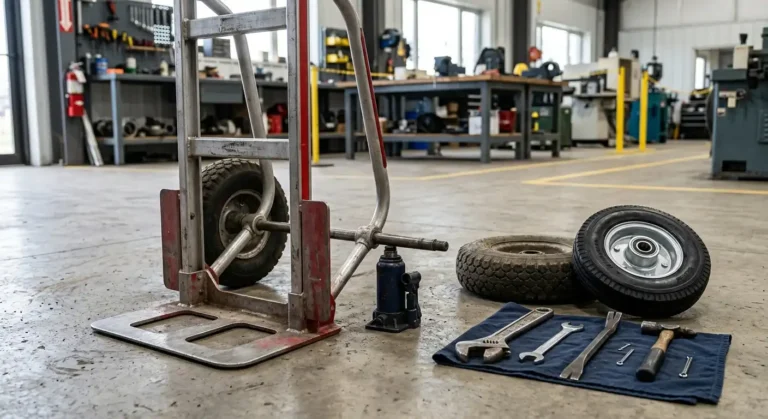
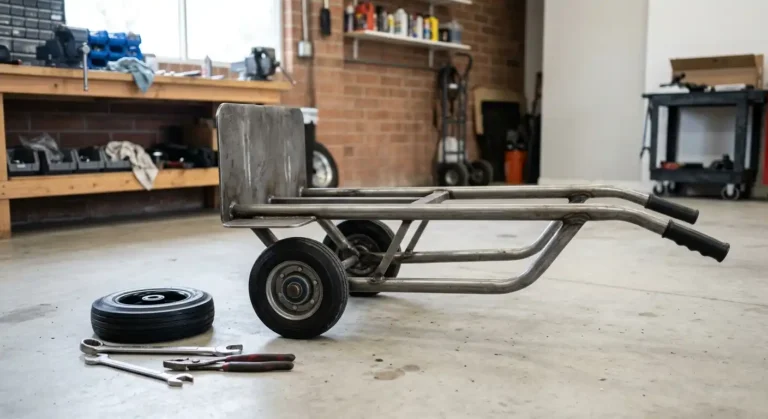
If you find cracked metal, broken welds, or loose wheels, remove the hand truck from service immediately. Refer to our guide on how to replace hand truck wheels if your cart needs maintenance.
Choose the Right Hand Truck for the Load
Hand trucks come in several designs tailored for specific tasks. Using the wrong style can make a load unstable and difficult to manage.
- Standard two-wheel hand trucks: Ideal for general boxes, cartons, and small stacks on smooth surfaces.
- Heavy-duty hand trucks: Built with reinforced steel frames for dense industrial loads. Review our comparison of aluminum vs steel hand trucks to match frame strength to your daily workload.
- Appliance hand trucks: Feature taller frames, built-in strap systems, and stair climbers designed specifically for refrigerators, washers, and water heaters.
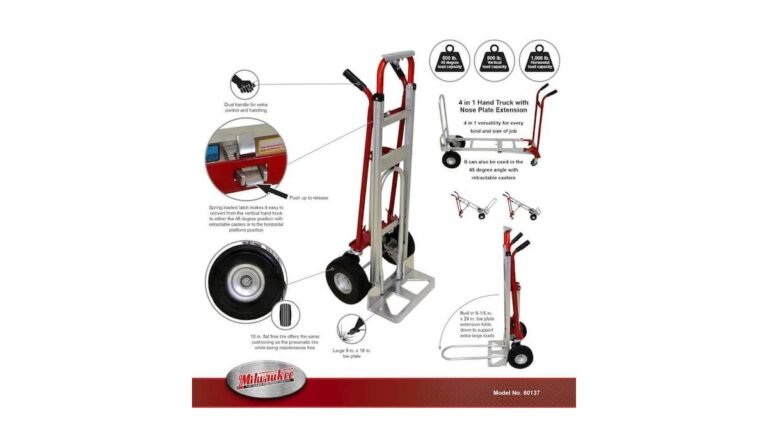
- Convertible hand trucks: Shift between a two-wheel upright and a four-wheel platform truck. See 2 wheel vs 4 wheel hand trucks to determine which configuration suits your pathway.
- Stair-climbing hand trucks: Equipped with rotating three-wheel assemblies or track systems for moving across steps.
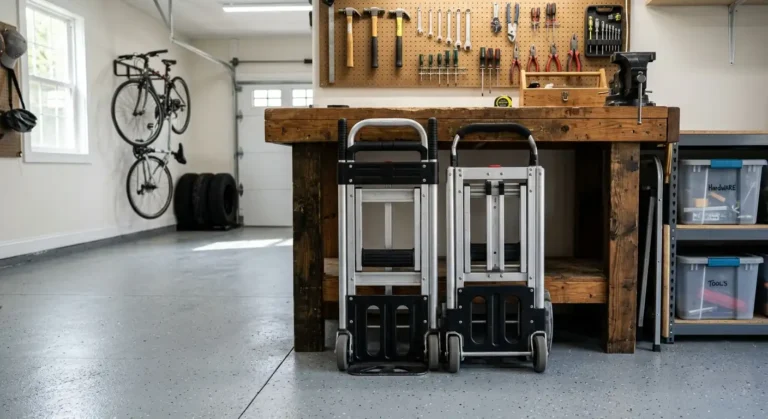
- Folding hand trucks: Lightweight models designed for compact storage and lighter loads.
Always consider the weight, size, shape, and stability of the item, as well as the surface you will travel over. Never exceed the manufacturer’s rated capacity for your specific model. For detailed weight limits, check our hand truck weight capacity guide.
How to Load a Hand Truck Safely?

Proper loading keeps the center of gravity low and prevents items from shifting in transit.
First, slide the toe plate completely under the load. If you are picking up a flat box or crate, tilt the item slightly forward, slide the nose plate fully underneath, and let the item rest back against the frame. Keep your feet clear of the toe plate while positioning the cargo to avoid pinching or crushing your toes.
Follow these loading principles:
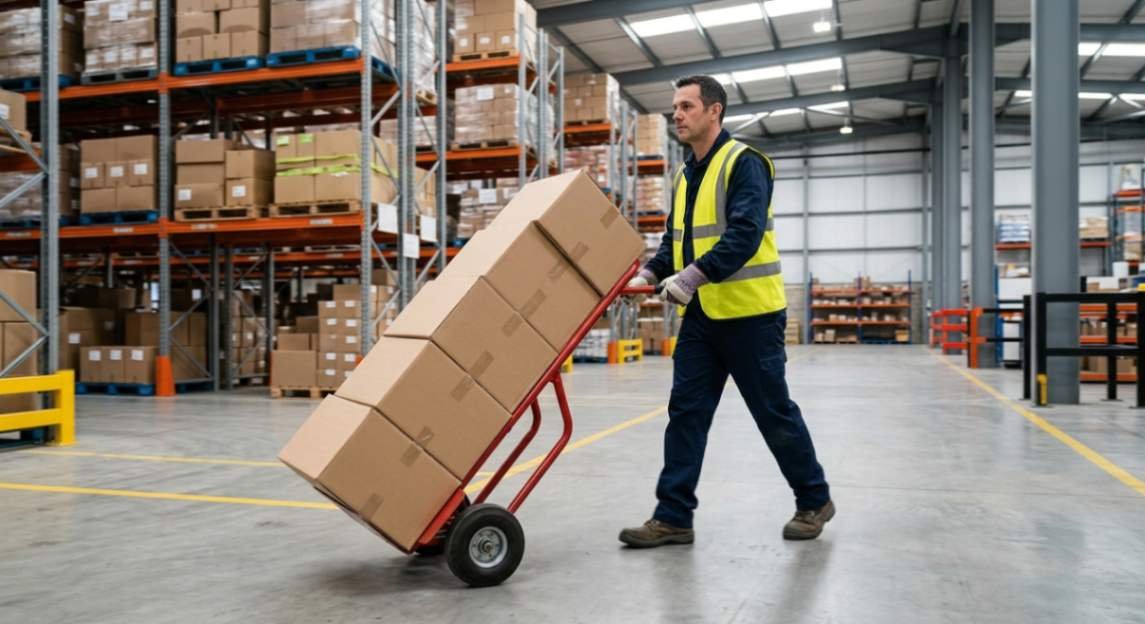
- Center the load: Position items squarely on the toe plate from left to right. An off-center load pulls to one side and can tip the cart.
- Place heavy items at the bottom: Always place the densest, heaviest boxes at the bottom of the stack. Stack lighter items on top to keep the center of gravity close to the wheels.
- Keep items against the frame: Stack cargo flush against the vertical uprights. Gaps between the load and the frame reduce leverage and make tilting the cart harder.
- Keep your view clear: Never stack boxes higher than your eye level. If a load blocks your forward vision, reduce the height of the stack.
- Secure loose or irregular items: Use cargo straps or bungee cords if the load consists of rounded objects, multiple loose boxes, or top-heavy equipment.
A poorly arranged load forces the operator to expend unnecessary energy balancing the cart instead of guiding it smoothly.
How to Tilt and Move a Hand Truck?
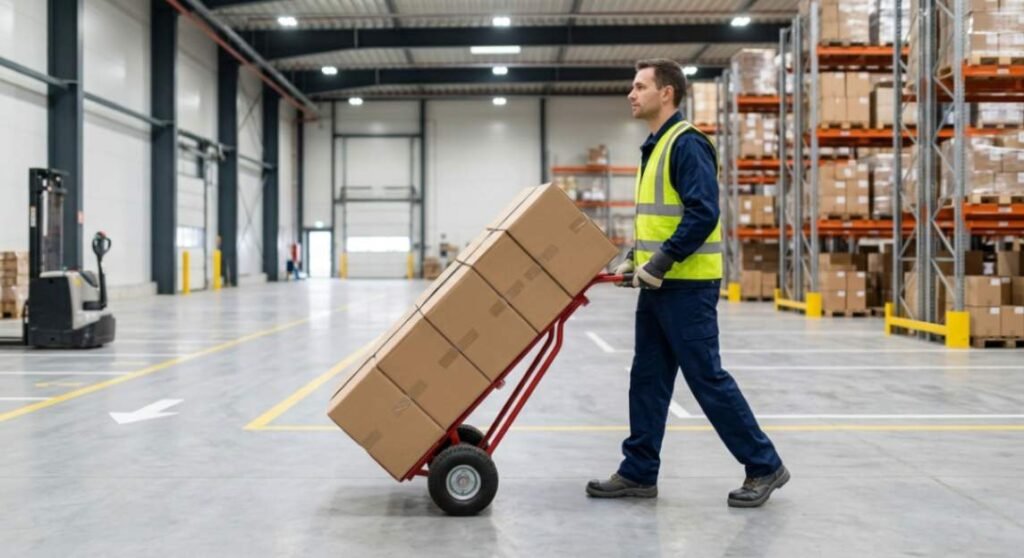
Tilting and rolling a loaded hand truck requires balanced body mechanics and steady pacing.
Tilting the Hand Truck
Stand directly behind the hand truck with a wide, stable stance. Place one foot against the axle or the designated heel bar to prevent the wheels from rolling backward. Grip the handles firmly with both hands. Pull the handles back toward your body smoothly, using your body weight and leg strength rather than your lower back. Let the frame pivot back until the load balances comfortably over the wheels.
Moving the Hand Truck
Once balanced, maintain a firm grip and keep the load tilted at a consistent angle. Do not tilt the hand truck too far back, as this transfers excessive weight to your arms and shoulders. Do not keep it too upright, or the load may fall forward over the toe plate.
- Maintain a controlled walking speed: Walk at a steady, manageable pace. Moving too fast makes it difficult to stop quickly if an obstacle appears.
- Keep the path clear: Look ahead along your entire travel route for debris, spills, or pedestrians.
- Avoid sudden turns and stops: Make wide, smooth turns. Sharp turns can cause tall loads to slide off the side of the toe plate.
- Pushing vs. pulling: There is no universal rule that applies to every hand truck. General ergonomic guidelines favor pushing because it uses stronger leg muscles and provides a clear view forward. However, standard two-wheel hand trucks are often tilted and pulled while walking backward for short distances or moving through tight doorways. Always follow the equipment design, load requirements, and manufacturer instructions for your specific unit.
Move Carefully Over Different Surfaces
Floor conditions significantly affect how a hand truck handles. Smooth concrete floors offer minimal rolling resistance, while rough outdoor terrain increases drag and instability.
- Rough concrete and gravel: Rough ground can catch small wheels and bring the cart to an abrupt stop. Hand trucks with larger pneumatic or solid rubber tires handle uneven ground better than small, hard plastic wheels. See our hand truck wheel size guide for wheel selection advice.
- Thresholds and small bumps: Approach door sills, expansion joints, and elevator gaps squarely at a right angle. Slow down and ease the wheels over the bump one at a time. Hitting a threshold at an angle can tip the cart sideways.
- Curbs: When stepping up a curb, back up to the curb, step onto the raised surface, and pull the wheels up squarely. When going down a curb, keep the hand truck behind you or ease the wheels down slowly while keeping the frame tilted back.
- Ramps and inclines: When moving up or down a ramp, keep the load uphill from you whenever possible. This prevents a runaway load if you lose your grip.
- Wet or slippery surfaces: Slow down on wet concrete, metal plates, or polished tile to maintain your footing and prevent the wheels from sliding.
How to Use a Hand Truck on Stairs?
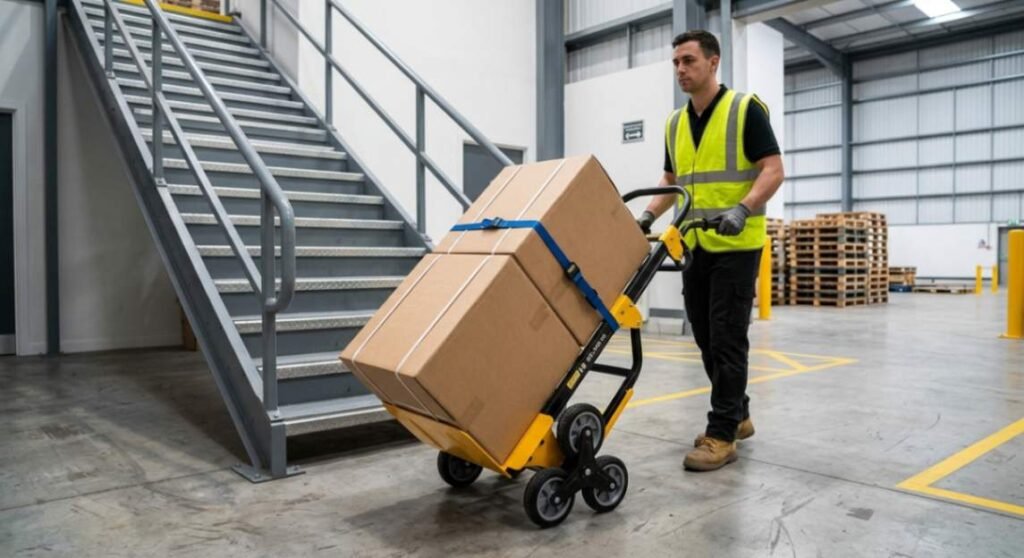
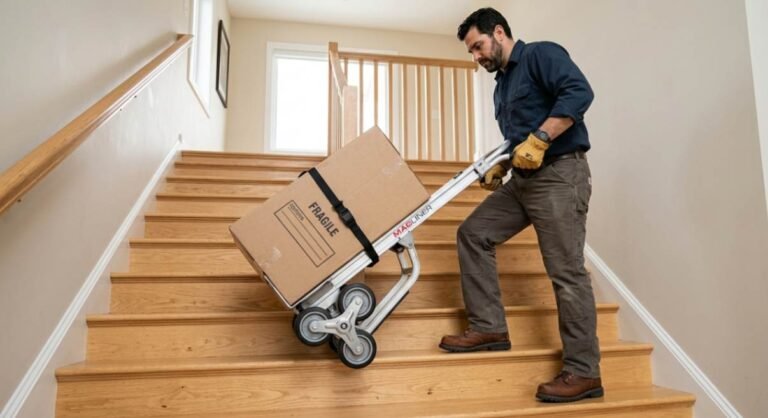
Stairs present significant safety risks, including sudden shock loads, loss of balance, and severe falls. A standard two-wheel hand truck should not automatically be assumed safe for stairs.
When stairs cannot be avoided, observe these safety measures:
- Use dedicated equipment: Use an appliance hand truck with built-in stair glides or a specialized stair-climbing hand truck with tri-wheel assemblies.
- Check the alternative routes: Use an elevator, freight lift, or access ramp whenever one is available.
- Never drag standard hand trucks down stairs: Dragging an ordinary hand truck down steps subjects the frame and operator to severe impact forces and can easily pull the worker down the flight.
- Get a spotter or assistant: Moving heavy loads across stairs should never be done alone. Have an assistant guide the path and help manage the load from below if trained and safe to do so.
- Secure the load: Always strap the load tightly to the frame before attempting stairs.
For detailed procedures on navigating steps with specialized equipment, read our dedicated article on how to use a hand truck on stairs.
Common Hand Truck Safety Mistakes to Avoid
Avoiding operational mistakes prevents equipment failure and dropped items:
- Exceeding rated capacity: Overloading bends toe plates, cracks frame welds, and damages wheel bearings.
- Using damaged hand trucks: Operating equipment with cracked frames, missing pins, or worn wheels leads to sudden failures.
- Stacking loads too high: Tall stacks block forward vision and raise the center of gravity, making the hand truck prone to tipping.
- Turning abruptly: Quick directional changes cause top-heavy items to shift and slide off the toe plate.
- Ignoring low tire pressure: Flat or underinflated pneumatic tires dramatically increase the effort needed to push or turn the cart.
- Using excessive force: If a load will not roll smoothly, forcing it can strain your body or damage the cart. Stop and check for wheel obstructions or excessive weight.
- Failing to secure awkward loads: Moving round barrels, tall furniture, or loose items without straps invites shifting.
- Using standard hand trucks on stairs: Attempting to bounce ordinary hand trucks down steps damages property and risks serious injury.
Maintain a Safe Body Position
Using sound body mechanics helps you manage heavy items with less physical effort:
- Keep a stable base of support: Stand with feet shoulder-width apart before tilting or moving a load.
- Use leg power: Bend at your knees and hips when tilting or lifting the hand truck handles. Use your legs rather than bending your back.
- Avoid twisting: Keep your shoulders and hips aligned with the direction of travel. Turn your entire body with your feet rather than twisting your torso.
- Maintain a firm grip: Keep both hands on the designated handle grips to maintain complete steering control.
- Do not overreach: Keep the hand truck handles within a comfortable reach. Reaching too far forward or back reduces your leverage.
Proper equipment selection and reducing the load weight are always safer than forcing an unmanageable load manually.
What to Do When a Load Is Too Heavy?
Never attempt to move a load that exceeds the rated capacity of your hand truck or your ability to control it safely.
- Break down the stack: Divide tall stacks into smaller, lighter loads that can be moved over multiple trips.
- Use a higher-capacity cart: Switch to a reinforced heavy-duty hand truck or an appliance cart rated for the weight.
- Switch to four-wheel equipment: For bulky or extremely dense cargo, a platform truck, pallet jack, or dolly may be more appropriate. See our guide on hand truck vs dolly to choose the right tool.
- Ask for help: Get a coworker to help balance the load, clear doorways, or assist on ramps.
Hand Truck Safety Checklist
Use this quick checklist before and during every move:
- Inspect the frame, welds, and toe plate for cracks or bends.
- Check wheels, bearings, and tire inflation levels.
- Confirm the load does not exceed the manufacturer’s rated capacity.
- Check the travel path for obstacles, spills, and clear doorway clearances.
- Center the load squarely against the frame.
- Place the heaviest items at the bottom of the stack.
- Keep the cargo height below your line of sight.
- Secure loose, round, or top-heavy items with straps.
- Maintain a firm grip and move at a controlled walking pace.
- Use dedicated stair-climbing equipment or ramps for level changes.
Frequently Asked Questions
There is no single rule for every situation. General ergonomic guidelines favor pushing because it uses leg muscles and provides clear forward visibility. However, standard two-wheel hand trucks are often tilted back and pulled when negotiating tight turns or short clearances. Follow the manufacturer’s recommendations and the physical design of your cart.
There is no universal weight limit for all hand trucks. Safe capacity depends entirely on the manufacturer’s rating for that specific model, which commonly ranges from 150 pounds on light folding models to over 1,000 pounds on heavy-duty industrial units. Always check the load capacity label on the frame and never exceed it.
Standard two-wheel hand trucks should not be used on stairs. Only hand trucks designed or approved for stair navigation—such as appliance hand trucks with stair climbers or tri-wheel models—should be used on steps, and loads must always be strapped securely to the frame.
Center the cargo on the toe plate, place the heaviest items at the bottom, keep the stack flush against the frame, and avoid stacking items above eye level. Use tie-down straps or bungee cords for loose or irregular items.
Stop immediately. Check whether the load exceeds the cart’s rated capacity, ensure the pneumatic tires are properly inflated, verify that the wheels turn freely, and inspect the floor surface for obstacles or debris. Do not attempt to force the cart forward.