
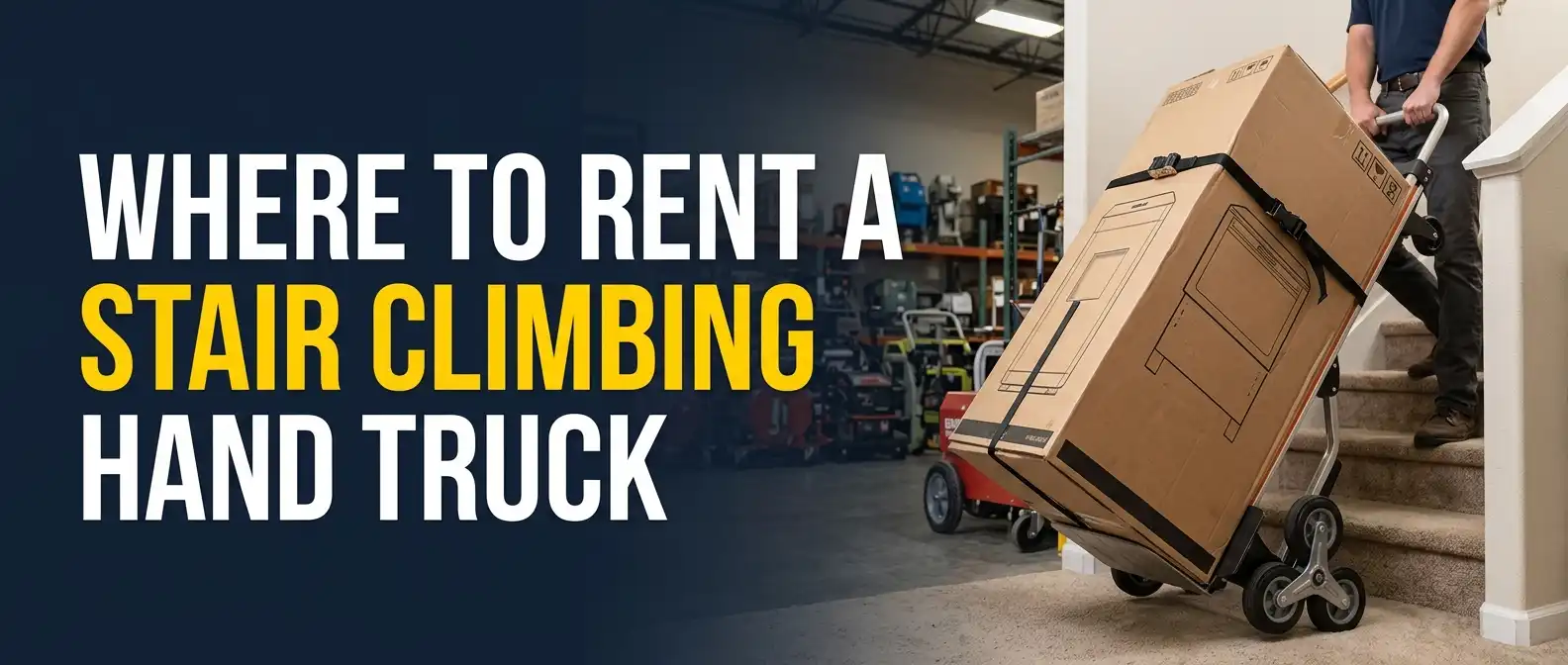
You can rent a stair climbing hand truck from commercial equipment rental companies, tool rental counters, and specialty material handling dealers. Because stair-climbing models are more specialized than standard utility dollies, equipment availability varies by branch. Always call the rental counter directly to verify that they stock an actual manual tri-wheel or powered stair-climbing machine before picking it up.
Unlike standard hand trucks, which are available at almost every rental counter, purpose-built stair climbing models are specialized tools. You must confirm that a location has an actual stair climbing unit in stock before you travel to pick it up.
Finding the right machine depends on what you need to move. A manual stair climber can help you maneuver moderate boxes and furniture up a short flight of steps. For large appliances, heavy boilers, or commercial machinery, you will likely need a heavy-duty appliance stair climber or a battery-powered motorized machine.
Because these units handle heavy loads on steep inclines, choosing the right model is critical for personal safety and property protection. Call rental businesses directly to verify the lifting capacity, wheel configuration, and battery condition of the tool.
Where Can You Rent a Stair Climbing Hand Truck?
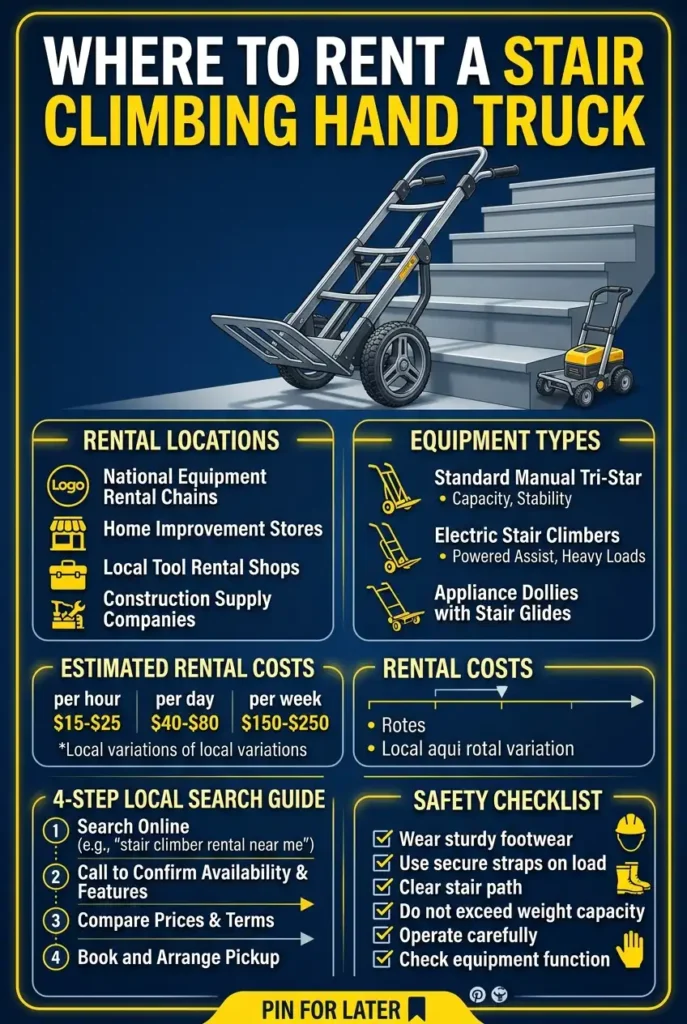
Not every business that rents moving supplies carries hand trucks designed for stairs. When searching for a rental, check these primary categories of equipment providers.
Equipment Rental Companies
Large commercial equipment rental providers cater to contractors, industrial warehouses, and commercial movers. These facilities frequently carry material handling tools designed for rough jobs and multi-floor transport.
Many commercial yards stock heavy-duty appliance dollies equipped with stair-climbing belts, and some carry powered electric stair climbers for heavy equipment. Inventory changes frequently based on local demand, so call the branch counter rather than relying solely on website listings.
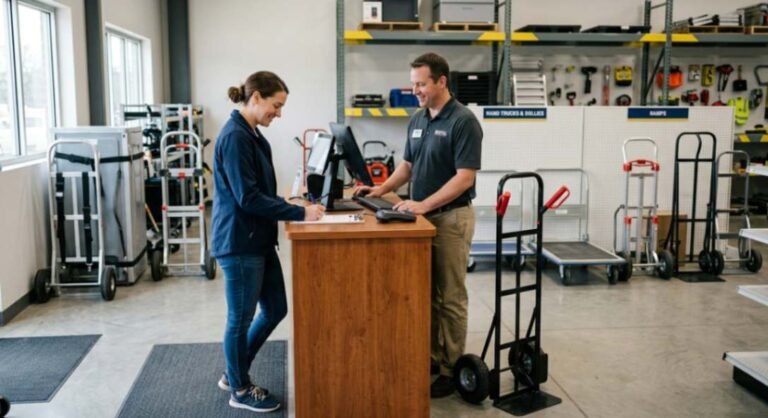
Tool Rental Stores
Hardware stores and independent home-improvement centers often run dedicated tool rental departments. These centers commonly carry standard two-wheel utility carts and moving dollies. Some locations also stock stair-climbing hand trucks with tri-star wheel clusters or manual stair glides. Always ask the rental clerk to inspect the physical unit to confirm it is engineered for stairs, as standard utility hand trucks are often mislabeled in general rental categories.
Moving Equipment Rental Companies
Truck rental companies and moving supply depots rent basic transport gear to help residential customers move households. While these outlets almost always offer basic utility hand trucks and appliance dollies, true stair-climbing hand trucks are less common. An appliance dolly from a moving company may feature built-in stair glides on the frame, but it will rarely feature mechanical or rotating stair-climbing mechanisms.
Specialty Equipment Rental Companies
Specialty material handling dealers focus exclusively on rigging gear, forklifts, hoists, and powered transport machines. If your job requires an electric stair-climbing hand truck to move a commercial safe, a vending machine, or an industrial printing unit, specialty rigging suppliers are your best option. These companies understand manufacturer ratings and can provide dedicated operator guidance for advanced motorized equipment.
Local Rental Businesses
Independent, family-owned party and equipment rental yards serve specific regional communities. These shops often maintain an eclectic fleet of material handling tools acquired to meet local customer requests. Calling a neighborhood rental store can yield fast results, as staff can check inventory and hold equipment for you immediately.
How to Find a Stair Climbing Hand Truck Rental Near You?
Locating a stair climber hand truck rental requires a focused search strategy. Searching online for generic phrases like “hand truck rental” or “dolly rental” will mostly return basic two-wheel carts that are unsafe for moving heavy items up steps.
Follow this step-by-step process to find the correct machine:
- Search with specific phrases. Search online for stair climbing hand truck rental, electric stair climber rental, or stair climbing dolly rental along with your city or postal code.
- Review online equipment catalogs. Check the specifications listed in the company’s material handling or moving equipment catalog.
- Call the specific branch directly. Do not rely on centralized online booking systems. National inventory portals do not always reflect broken, rented, or retired equipment at a specific branch.
- Identify the exact model type. Ask the counter representative whether the unit is a manual model with a three-wheel cluster, a frame with rubber stair belts, or a motorized climbing unit.
- Confirm the rated load capacity. Give the counter associate the estimated weight and dimensions of your cargo to ensure the tool can handle the load safely.
- Ask about required accessories. Confirm that the rental includes load-securing straps, and ask whether powered units come with a fully charged battery and charger.
- Verify pricing and deposits. Ask for the total out-the-door price, including mandatory damage waivers, local taxes, and refundable security deposits.
- Place an advance reservation. Reserve the unit for your target date and time so the branch does not dispatch it to a contractor before you arrive.
What Type of Stair Climbing Hand Truck Do You Need?
Stair climbing hand trucks fall into distinct categories based on their mechanical design, power source, and intended payload. Matching the equipment to your load and stairway layout prevents accidents and physical strain.
Manual Stair Climbing Hand Trucks
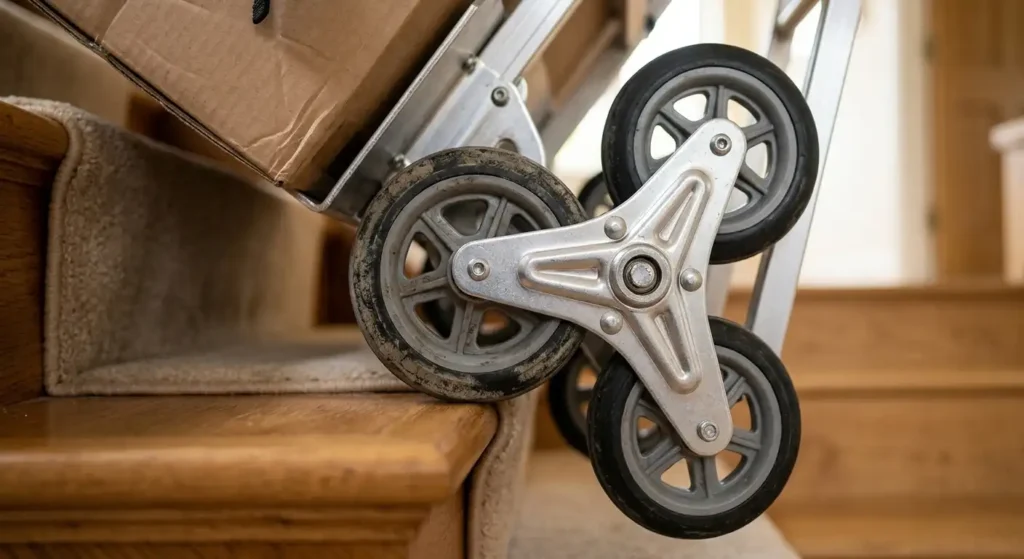
Manual stair climbing hand trucks typically utilize a tri-star wheel assembly. On each side of the frame, three wheels rotate around a central axis. As you pull the cart up a step, the bottom wheel catches the stair riser, pivoting the next wheel onto the upper step tread.
These carts work well for standard boxes, file cabinets, and mid-weight furniture items. They rely entirely on human effort to lift and stabilize the load. If you are learning the basic anatomy of standard transport tools, read our foundational guide on what is a hand truck to see how frames, nose plates, and wheel mountings function together.
Powered Stair Climbing Hand Trucks
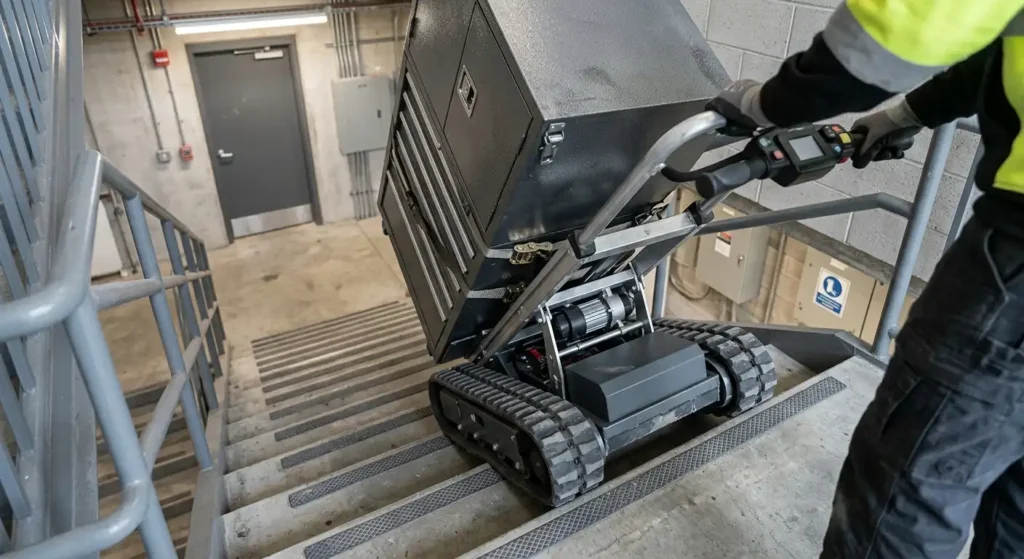
Powered stair climbing hand trucks use an electric motor and rechargeable battery pack to lift heavy loads up and down steps. Some powered models use rotating mechanical lifting feet that push against the step tread to elevate the frame. Others utilize heavy-duty rubber crawler tracks that drive smoothly over the stair nosing.
Electric units dramatically reduce back strain and cardiac stress during multi-story moves. Because these machines are heavy and powerful, operators must review the manufacturer’s operational manual carefully. Operating the drive controls incorrectly on an incline can cause the machine to slip or tip backward.
Heavy Duty or Appliance Stair Climbers
Large household appliances like refrigerators, water heaters, and washing machines present balance challenges on steps due to their tall profiles. Heavy-duty appliance hand trucks feature tall, reinforced steel or aluminum frames, integrated tension straps, and continuous rubber stair glides mounted behind the main wheels.
These rubber stair glides bridge the gap across step edges, allowing the operator to slide the load down or pull it up without metal-on-concrete impact. When renting, choose equipment based on the actual physical dimensions and manufacturer-certified load ratings rather than the visual size of the cart.
Review our hand truck weight capacity guide to learn how structural materials dictate safe working limits.
How Much Does It Cost to Rent a Stair Climbing Hand Truck?
Rental pricing for stair climbing equipment varies significantly based on whether you rent a manual cart or a motorized, battery-operated climbing machine. Rental costs depend on:
- Equipment complexity: Simple manual tri-wheel carts cost far less than complex electric stair climbers.
- Payload capacity: High-capacity units made of reinforced steel or engineered alloys command higher rates.
- Geographic market: Rental branches in major metropolitan regions often charge higher rates than rural rental yards.
- Rental duration: Most companies offer 4-hour, 24-hour daily, weekend, and weekly rates.
- Ancillary fees: Security deposits, environmental fees, equipment protection plans, and local sales taxes affect the total invoice.
Manual stair-climbing hand trucks and appliance dollies with stair glides generally rent between $15 and $35 for a standard single-day rental. A weekend rental may range from $25 to $50, while a full weekly rate usually falls between $60 and $120.
Powered electric stair climbing hand trucks are professional industrial tools that represent substantial capital investments for rental stores. Consequently, rental rates for powered units are higher. A commercial electric stair climber often costs between $75 and $200 per day, with weekly rates running from $300 to over $700 depending on the model and lifting mechanism.
Many rental counters also require an authorization hold or refundable security deposit of $100 to $500 on credit cards for motorized units. Always ask the rental branch for a complete quote showing the final balance before committing.
Questions to Ask Before Renting a Stair Climbing Hand Truck
Before signing a rental contract and loading the equipment into your vehicle, review this operational checklist with the rental desk staff:
- What is the maximum rated load capacity? Confirm that the rating safely exceeds the weight of your item.
- Does the load capacity change on stairs? Some manufacturers establish lower weight ratings for stair travel than for flat-surface rolling.
- Is the unit manual or motorized? Verify whether moving the load up steps relies on physical pulling or mechanical drive assistance.
- What stair surfaces and profiles can the unit handle? Ask if the wheels or tracks are safe for finished hardwood, open-grate industrial metal, stone, or carpeted steps.
- What are the overall dimensions and empty weight of the cart? Ensure the machine will fit through your stairwells and into your transport vehicle.
- Are heavy-duty tie-down straps included? Never move an appliance or large item on stairs without securing it firmly to the frame with an integrated ratchet or cam-buckle strap.
- What battery accessories come with powered units? Confirm that the battery is fully charged, ask for the expected run-time per cycle, and verify that the correct wall charger is provided.
- Is special operator training required? Request a hands-on demonstration of safety switches, emergency brakes, and ascent/descent drive controls.
- What is the minimum rental period and return policy? Clarify return cutoff times and potential grace periods to avoid paying unexpected second-day rental fees.
- Who do I call if the machine malfunctions? Ask what support or replacement options the rental company provides if the equipment fails during your project.
Can You Rent a Regular Hand Truck Instead?
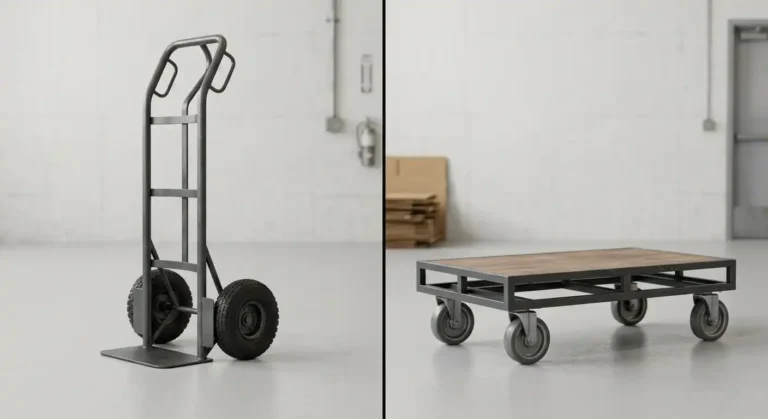
A standard two-wheel utility hand truck is engineered primarily for rolling balanced freight over flat, level ground. While you can find standard hand trucks at almost any tool rental counter, they are not a substitute for dedicated stair climbing equipment.
Using an ordinary hand truck on a staircase creates significant safety hazards. Standard tires hit the edge of each step tread, requiring the operator to exert substantial upward force to jerk the wheels over each riser. This sudden motion destabilizes the cargo, increases the risk of dropped loads, and places extreme mechanical strain on the operator’s lower back, shoulders, and arms.
Purpose-built stair climbing equipment uses rotating tri-wheel hubs or continuous friction belts to keep the load supported as it transitions between steps. If you are assessing the differences between basic moving gear, review our guide comparing a hand truck vs dolly to understand how load orientation affects handling.
When your move requires transporting bulky or heavy items between floors, use equipment specifically certified by the manufacturer for stair travel.
What to Check Before Picking Up the Rental?
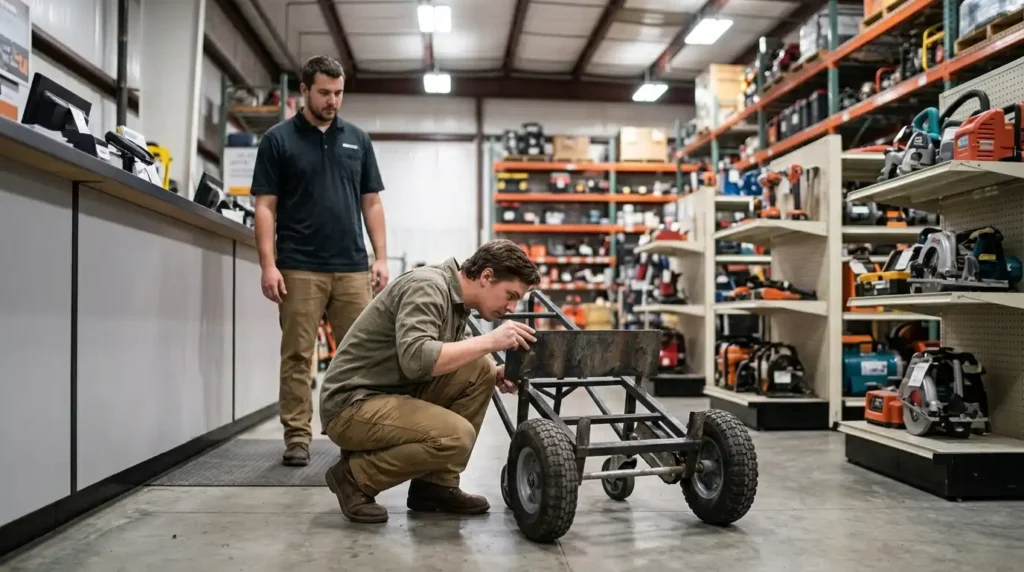
Before you leave the rental yard, perform a thorough physical inspection of the equipment. Identifying damage before you leave ensures you do not receive unsafe equipment or get charged for pre-existing defects upon return.
- Inspect the frame and weldments: Look closely for bent frame rails, cracked structural welds, or severe corrosion that could compromise the cart’s structural integrity under load.
- Examine the wheels and tires: Check that the wheels spin freely without binding on their axles. If the cart uses air-filled tires, confirm they are properly inflated. For a breakdown of how tire construction affects load rolling performance, read our comparison of pneumatic vs flat free tires.
- Check the wheel dimensions: Verify that the wheel diameter is large enough to roll over stair nosings without high friction. Our hand truck wheel size guide details how wheel dimensions influence clearance.
- Test the stair climbing mechanism: For manual tri-wheel carts, rotate the assemblies by hand to ensure the central pivot bearings turn freely. For belted dollies, check that the rubber stair glides are not torn, missing, or worn down to the bare metal fasteners.
- Inspect the nose plate: Confirm that the toe plate is straight, seated firmly against the frame, and free of stress cracks.
- Check tie-down straps: Inspect built-in web straps for fraying, cuts, broken stitching, or jammed ratcheting mechanisms.
- Test electrical controls and batteries: If you rent a powered unit, turn on the master switch, verify battery charge levels, check the emergency reverse or stop buttons, and test the drive controls in both directions.
Take clear photographs of any pre-existing scratches, dented rails, or worn straps while at the rental counter, and ask the clerk to note these issues on the rental agreement.
How to Use a Stair Climbing Hand Truck Safely?
Operating a hand truck on an incline introduces balance, gravity, and momentum challenges that do not exist on flat concrete. Safe operation protects your physical health and prevents catastrophic property damage.
For a detailed walkthrough on controlling balance, body mechanics, and step transitions, read our comprehensive guide on how to use a hand truck on stairs safely.
Always secure the load firmly to the hand truck frame using heavy-duty straps before approaching the staircase. An unsecured box or appliance can shift during step impacts, pulling the operator off balance.
Ensure the stairway is clean, bone dry, and illuminated. Remove loose runner rugs, extension cords, and threshold obstacles before starting. Wear heavy-duty work gloves and closed-toe safety boots with high-traction soles.
When moving heavy loads on stairs, assign a second person to act as a spotter. The spotter should stand on the opposite side of the load to watch for step clearances, keep bystanders away, and provide steadying support if directed. Never stand directly beneath an unsupported heavy load on a staircase. If you feel the machine slipping or tilting beyond your control, do not try to stop a falling multi-hundred-pound machine with your body.
For general material handling practices on flat ground, review our complete overview on how to use a hand truck safely.
What If You Cannot Find a Stair Climbing Hand Truck for Rent?
Because stair-climbing hand trucks are specialized equipment, your local rental counters may occasionally have none available. If you cannot rent one locally, consider these practical alternatives:
- Contact commercial rigging and material handling suppliers: Industrial suppliers that sell forklifts, pallet jacks, and overhead hoists frequently maintain small rental fleets of powered stair crawlers for industrial clients.
- Hire professional moving labor: If you are moving a massive or high-value item like a cast-iron stove, commercial safe, or large French-door refrigerator, hiring professional movers with their own specialized equipment is often cheaper than repairing personal injuries or broken stairs.
- Use an appliance delivery service: Many local retail logistics providers offer transport-only services to move individual heavy appliances between addresses or up flights of steps.
- Consider purchasing a manual tri-wheel unit: If you anticipate ongoing multi-floor moving needs, purchasing an affordable manual stair climbing cart may be practical. Compare the frame durability of aluminum vs steel hand trucks to decide which material matches your budget and physical strength.
Should You Rent or Buy a Stair Climbing Hand Truck?
Deciding whether to rent or purchase a stair-climbing hand truck comes down to project frequency, payload weights, and available storage space.
When Renting Makes Sense
Renting is the most sensible option for one-time home relocations, occasional appliance installations, or short-term maintenance projects. A high-end powered stair climber can cost anywhere from $1,500 to over $6,000 to purchase new. Renting allows you to access commercial-grade motorized equipment for a fraction of that cost without taking on long-term maintenance, battery replacements, or storage issues.
When Buying Makes Sense
Purchasing equipment is the better choice for independent contractors, appliance delivery drivers, maintenance departments, and property managers overseeing multi-story buildings without elevators. If you regularly transport heavy gear up steps, the cumulative rental fees and time spent picking up and returning equipment will quickly exceed the purchase price of a manual or entry-level powered machine.
Frequently Asked Questions
Yes, you can rent a stair climbing hand truck, but availability is more limited than standard utility hand trucks. You can find them at commercial equipment rental businesses, tool rental centers, and specialty material handling suppliers. Availability varies by branch, so call ahead to verify stock.
To find a local rental, search for general equipment rental companies, independent tool rental shops, and specialty material handling dealers in your area. For general advice on locating rental providers, review our guide on where to rent hand trucks.
A manual stair climbing cart or an appliance dolly with stair glides typically costs between $15 and $35 per day. Powered electric stair climbers generally rent for between $75 and $200 per day, plus security deposits, optional damage waivers, and sales taxes.
The Home Depot Tool Rental centers frequently rent standard hand trucks, heavy-duty appliance dollies, and moving carts. Some locations stock hand trucks with stair glides or tri-wheel designs, but inventory varies by store. Learn more about their policies in our detailed guide answering can you rent a hand truck at Home Depot.
U-Haul locations rent standard utility hand trucks and appliance dollies with built-in stair glides at most company-owned centers. However, U-Haul does not typically stock tri-star wheel climbers or powered electric stair climbers. For a complete look at their rental fleet, see our guide on does U-Haul rent hand trucks.
Select Lowe’s stores feature tool rental departments that offer commercial moving gear and material handling tools. Availability varies significantly by location, and not all stores offer tool rentals. Review our overview detailing does Lowe’s rent hand trucks to see what moving equipment they typically carry.
Final Answer
Start your search by calling local commercial equipment rental yards, dedicated tool rental centers, and specialty material handling distributors. Describe the exact weight and dimensions of the item you need to transport, and verify that the company has a verified stair-climbing model available for your target dates.
Confirm the maximum load capacity, check whether the tool is manual or battery-powered, inspect the frame and straps before signing the rental contract, and confirm the total price including deposits. Securing the correct equipment ensures you move your cargo safely without risking personal injury or damaging your staircase.