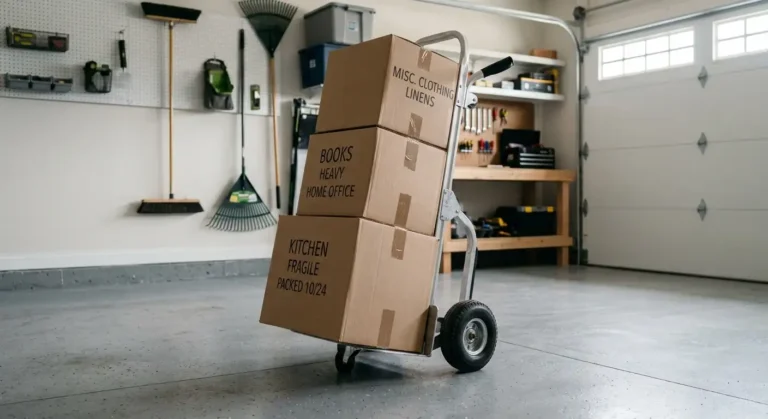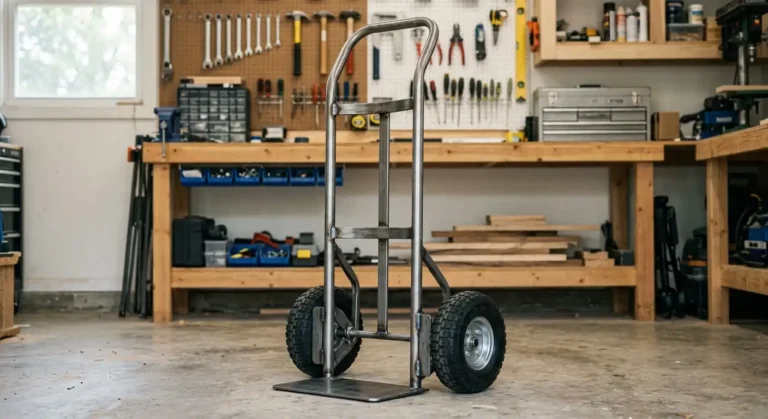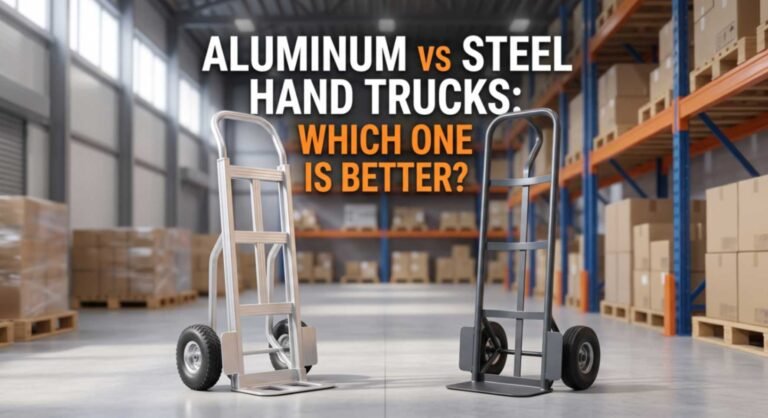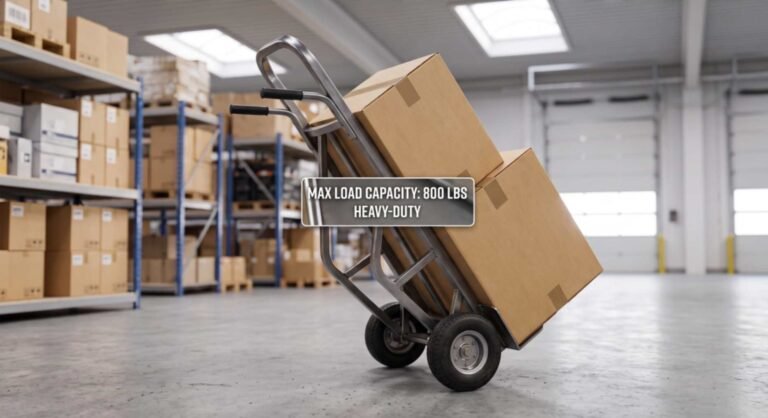

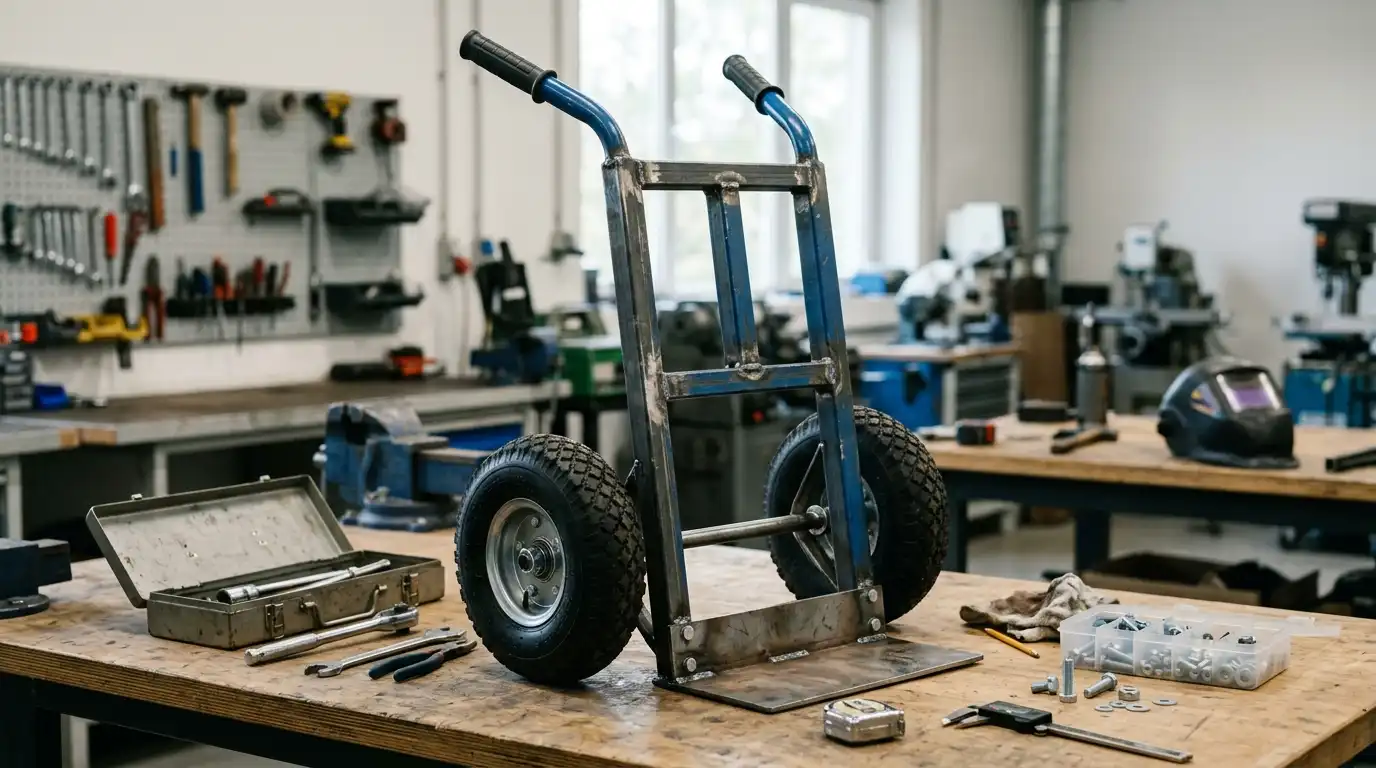
A hand truck dolly makes moving heavy boxes and household items much easier. It uses a simple lever design, an upright frame, two wheels, and a flat plate that slides under objects so you can tilt and roll them. Building your own DIY hand truck lets you customize the dimensions for specific jobs around your home or workshop.
This guide explains how to make a hand truck dolly from scratch, including planning the frame, mounting the axle, installing the wheels, and testing the finished build. Keep in mind that a homemade hand truck must be handled with care. Its real strength depends on your materials, joints, fasteners, axle, wheels, and assembly quality.
Before moving heavy items, take time to review how to use a hand truck safely to prevent accidents and property damage.
What Is a Hand Truck Dolly?
A basic two wheel hand truck features an upright frame, two handles at the top, an axle with two wheels at the base, and a horizontal toe plate at the bottom. To move an item, you slide the toe plate beneath it, pull the top handles backward to tilt the load onto the wheels, and push or pull it forward.
People often mix up these terms. A standard hand truck is an upright, two wheeled lever. A furniture dolly or platform dolly is usually a flat, four wheeled platform that sits low to the ground. If you want to explore the differences between these tools, read our detailed guide on hand truck vs dolly.
Can You Make a Hand Truck Dolly at Home?
Yes, you can build a basic hand truck dolly at home if you have basic workshop tools and fabrication experience. However, your design must always match the work you expect it to handle.
When planning a build, you must carefully evaluate several details:
- Frame material and joint strength
- Wheel diameter, hub type, and rated capacity
- Axle thickness and support structure
- Toe plate thickness and attachment points
- Quality of all bolts, pins, or structural welds
- Center of gravity and load placement
- The ground surfaces where you plan to roll it
A homemade hand truck should never be treated as equivalent to an engineered industrial model. It is suitable for light to medium household tasks, but it should not be trusted with dangerous, fragile, or extreme loads.
Materials You Need
The exact materials you choose depend on whether you build a metal or wooden hand truck. You can adapt these supplies to suit your specific project:
- Steel square tubing, steel angle, aluminum channel, or dense structural hardwood for the main vertical rails and horizontal crossbars
- Heavy gauge steel plate, thick aluminum plate, or reinforced hardwood for the bottom toe plate
- Two sturdy wheels matched to your intended rolling surface
- Solid steel round rod for the axle
- Axle mounting hardware such as pillow block bearings, drilled steel brackets, or axle tube sleeves
- Heavy duty steel washers that fit your axle diameter
- Locking axle hardware such as cotter pins, lock nuts, or shaft collars
- High strength bolts, lock washers, and locking nuts for mechanical joints
- Corner brackets or gusset plates for joint reinforcement
- Handle grips or protective rubber padding for comfortable handling
Every build is different. Do not treat any single thickness or material size as a universal standard for every hand truck.
Tools You Need
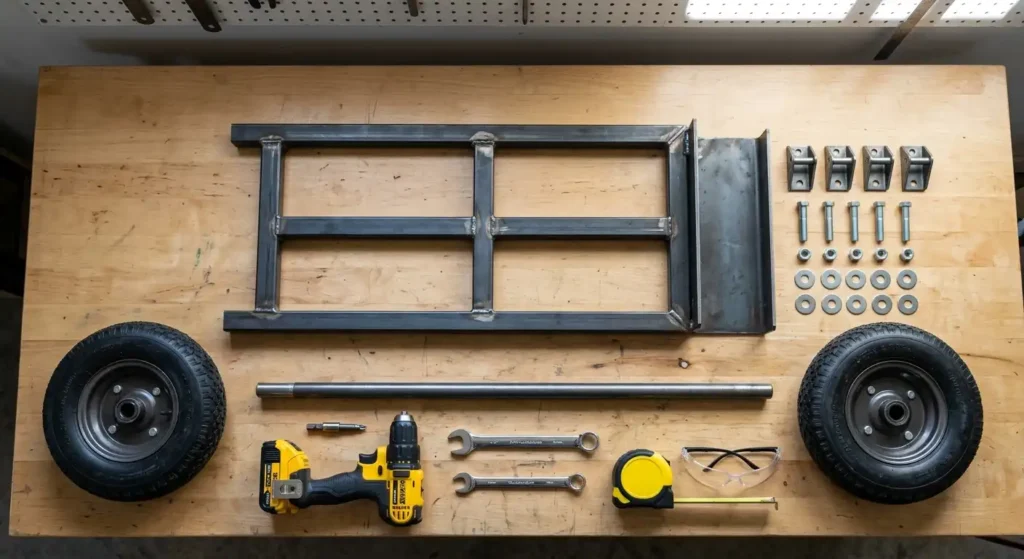
Gathering the right tools before you begin keeps the process smooth and safe:
- Measuring tape
- Fine marker or layout scribe
- Power drill with bits sized for wood and metal
- Socket set and open end wrenches
- Metal cutting saw, chop saw, or hacksaw
- Hand files or an angle grinder for deburring edges
- Heavy duty bar clamps or C-clamps
- Impact resistant safety glasses
- Heavy leather work gloves
If you choose to build a welded steel frame, you will need suitable welding equipment and a welding helmet. Structural welding must only be performed by someone with proper training, protective gear, and working knowledge of metal penetration.
How to Make a Hand Truck Dolly Step by Step?
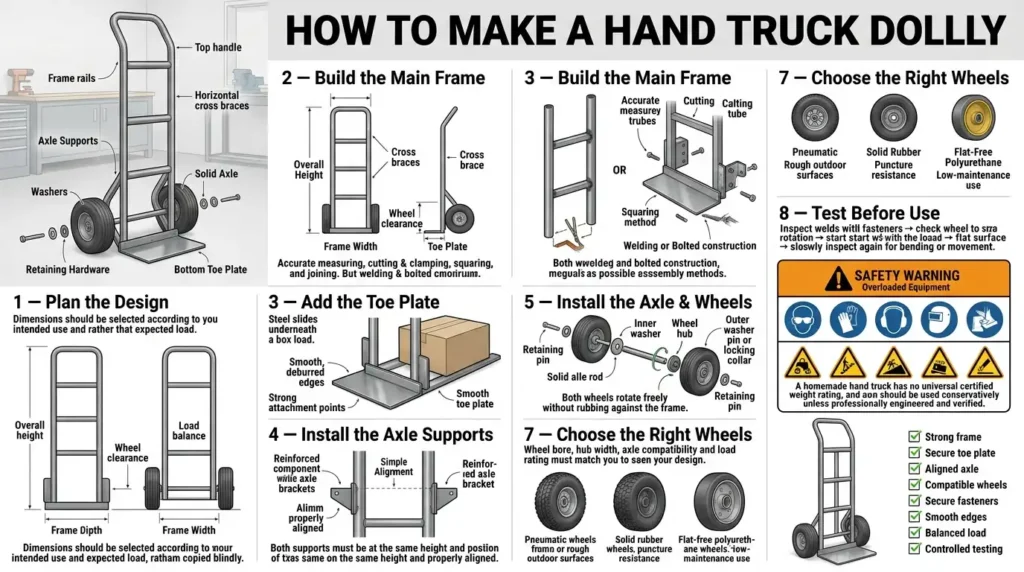
Follow these sequential steps to plan, build, align, and test your homemade hand truck.
1. Plan the Design
Before cutting any stock, sketch your design on paper. Decide what items you plan to move, their general dimensions, and how tall the frame should stand. A frame that reaches roughly chest height provides comfortable leverage when tilting a load back.
Plan the width of the frame, the depth of the bottom toe plate, and the placement of the axle. Keeping the load positioned close to the frame and directly above or slightly forward of the wheels gives you the best control. If the load sits too far forward of the wheel axis, you will have to fight excess downward weight at the handles. If it sits too far behind the axle, the hand truck can tip backward toward you.
2. Build the Main Frame
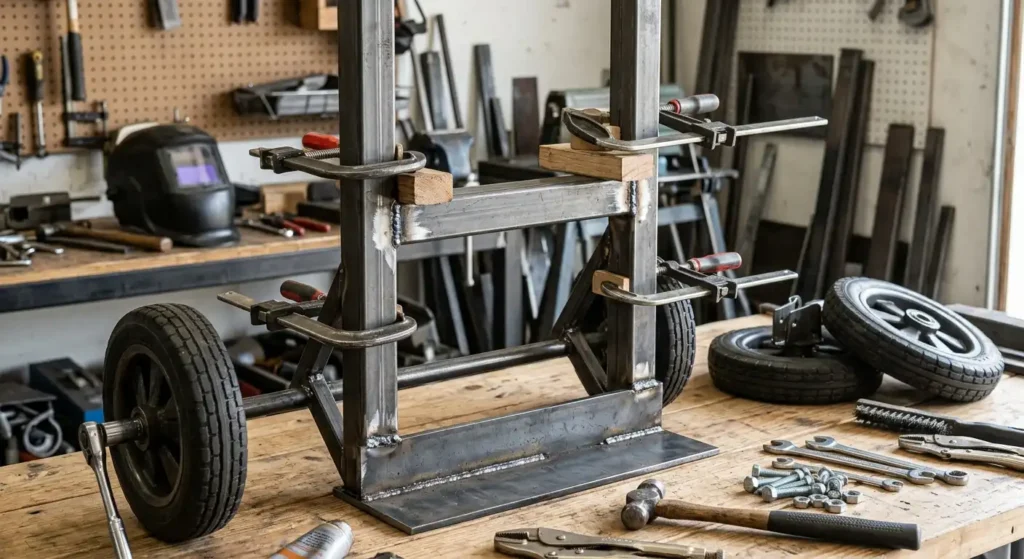
The upright frame forms the backbone of the hand truck. Cut two matching vertical rails and at least three horizontal crossbars. The lowest crossbar provides support near the wheels, the middle crossbar stabilizes the frame body, and the upper crossbar braces the handle area.
For a metal frame, square the parts using clamps on a flat bench. Join the pieces using clean structural welds or heavy duty angle brackets with through bolts. If you are building a wooden frame, use straight, defect-free lumber joined with mortise joints, lap joints, or steel reinforcement plates secured with through bolts.
Keep both vertical rails parallel and square. A crooked frame causes uneven stress on the axle, making the hand truck pull to one side under load. A weak joint can snap without warning, so take your time reinforcing every intersection.
3. Attach the Toe Plate
The toe plate, also called the nose plate, slides under the cargo to support its base weight. It transfers forces directly into the vertical frame rails and down toward the axle.
Position the plate squarely across the base of the two vertical rails. For a metal frame, weld the plate along the front face and underneath, or bolt it through heavy steel angle brackets. For a wooden build, secure a rigid plate with multiple through bolts backed by large washers to prevent the fasteners from crushing into the wood grain.
File all front and side edges smooth so the metal does not cut hands or damage furniture. Before moving on, press firmly on the toe plate to confirm it does not bend or flex away from the frame rails.
4. Install the Axle
The axle carries the entire rolling load and transfers motion through the wheels. It must be straight, rigid, and firmly attached to the lower rear section of the frame.
Mount the axle slightly behind the vertical frame rails using drilled steel tabs, structural U-bolts, or pillow blocks securely attached to the uprights. The axle must sit perpendicular to the vertical frame rails. If the axle is crooked, the hand truck will scrub its tires and resist rolling in a straight line.
Choose an axle diameter that matches your wheel bearings cleanly without sloppy play. Never use threaded rod as an axle for heavy jobs, as the threads create weak stress points that can bend easily under load.
5. Install the Wheels
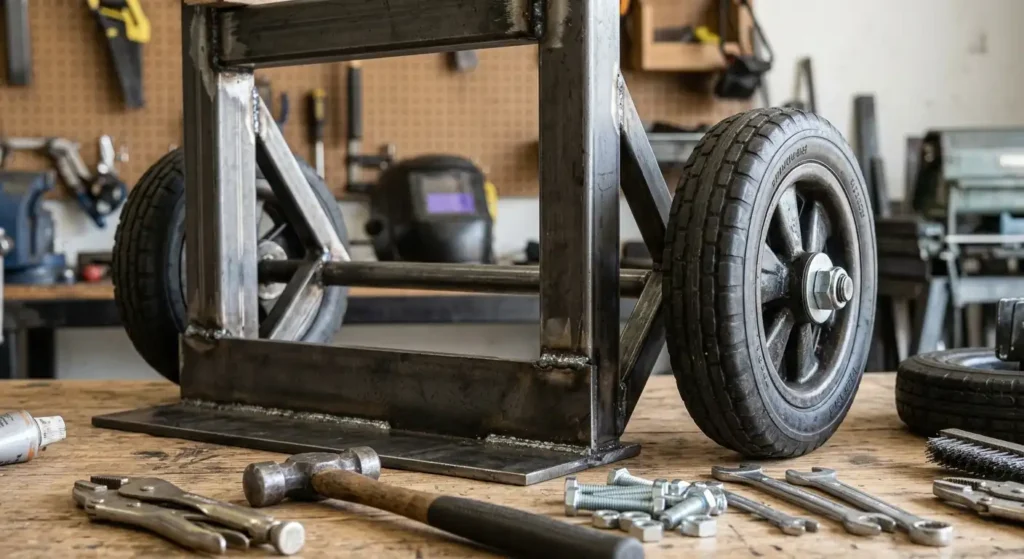
Slide an inner washer onto each end of the axle to prevent the wheel hub from rubbing directly against the frame brackets. Slide the wheels onto the axle ends, followed by an outer flat washer.
Secure each wheel in place using lock nuts, tight shaft collars, or cotter pins inserted through precision drilled holes in the axle ends. Check that the retaining hardware cannot slip or rattle off during movement. Spin each wheel by hand. Both wheels should rotate freely without binding, but they should not have excessive side-to-side wobble on the shaft. Never force mismatched wheels onto an incompatible axle.
6. Add the Handle and Reinforcement
The upper section of the hand truck requires comfortable, rigid handles. You can shape the top of the vertical rails into rounded grips, connect them with a continuous curved loop bar, or bolt on dedicated ergonomic handle extensions.
Inspect the lower third of the frame where forces concentrate during tilting. Add corner gussets or diagonal brace tubes between the bottom crossbar and the vertical rails. Strengthening this area prevents the frame from bending backward when you pull down on the handles to lift a load.
7. Smooth and Finish the Frame
Safety during handling depends on a clean exterior. Use a hand file or grinder to remove all sharp metal burrs, weld spatter, and rough edges along the rails, toe plate, and axle mounts. If you built a wooden dolly, sand down rough spots to prevent splinters.
Check all bolts and lock nuts to confirm they are fully tightened. Apply a coat of metal primer and paint to bare steel parts to stop rust from forming. Add rubber or vinyl handle grips to the top rails to give your hands a positive, slip-resistant hold.
8. Inspect and Test the Finished Hand Truck
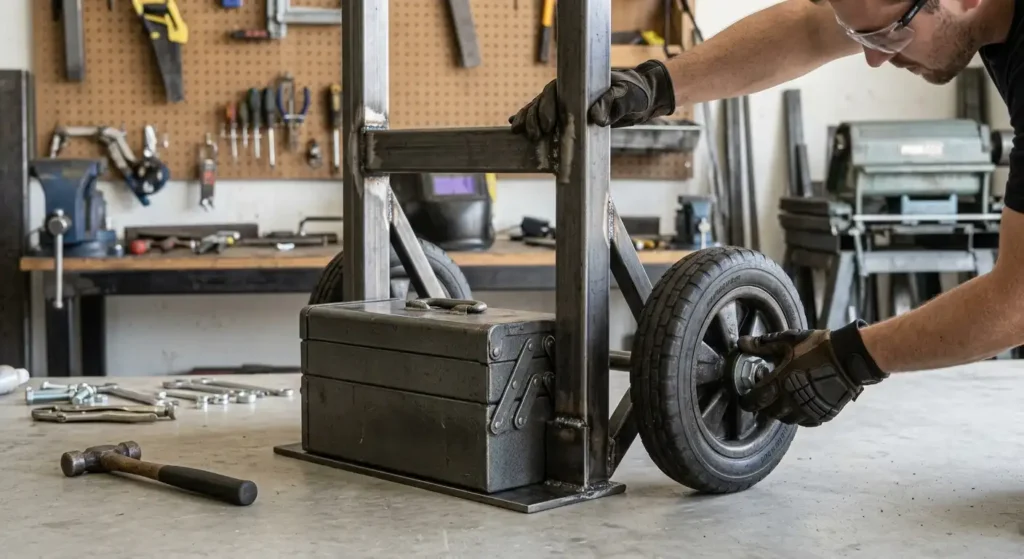
Never load a newly built hand truck to maximum capacity right away. Begin with a thorough visual inspection:
- Check every joint, bolt, bracket, and weld for cracks or gaps
- Confirm that the axle sits firmly in its mounts without movement
- Ensure both wheel retainers are locked securely
- Verify that the toe plate is rigid and square to the frame
Once visual checks pass, place a light, flat box weighing around 20 to 30 pounds on the toe plate. Tilt the hand truck backward on a smooth, level floor. Check how the frame responds to the leverage. Roll it forward, turn it in both directions, and listen for unusual creaks, grinding, or flex.
If the frame remains rigid and tracks straight, you can test slightly heavier household loads in controlled steps. Remember that simple testing on a flat floor confirms basic function, but it does not establish a certified load limit.
How to Make a Wooden Hand Truck Dolly?
You can build a serviceable light-duty hand truck using dense hardwood like oak, ash, or maple. Avoid soft construction pine for structural uprights because it splits easily under tension.
Cut your vertical frame rails and crossbars from solid stock. Fasten the joints with mechanical through bolts rather than simple wood screws or nails, which pull out easily under leverage. Add steel corner brackets at every joint to resist twisting forces.
Wood naturally responds to moisture changes and can crack, splinter, or loosen around bolt holes over time. Inspect all wooden components and tighten loose hardware before every single use. Keep your wooden dolly stored in a dry indoor area to preserve its strength.
How to Make a Hand Truck Dolly From an Old Dolly?
Modifying a discarded or broken hand truck can save you time and fabrication effort. Before reusing old parts, inspect the original frame, axle mounts, and wheel hubs for metal fatigue, rust pitting, or hidden cracks.
You can replace worn-out wheels, install a wider toe plate, or graft on new handles to match your height. However, do not assume an old frame retains its original strength, especially if it was left outdoors. Relocating the axle or altering the frame height changes the center of gravity and leverage balance, so re-test the modified equipment slowly with small loads.
How to Choose Wheels for a DIY Hand Truck?
Selecting the right hand truck wheels directly affects how easily your cart moves over different surfaces:
- Pneumatic wheels: These air-filled rubber tires provide good shock absorption over gravel, rough dirt, and lawn surfaces. However, they require regular pressure checks and can go flat from punctures.
- Flat-free polyurethane wheels: These solid foam-filled tires roll smoothly over rough ground without ever losing air pressure, making them low maintenance.
- Hard rubber or solid plastic wheels: Best for smooth concrete floors in garages and basements. They carry weight well without flat spots, but they create a rough ride over bumps.
Consider the wheel diameter, hub width, bearing size, and rated wheel capacity. Larger diameter wheels roll over obstacles and thresholds with less pushing effort. For more information on matching tire size to your work, refer to our hand truck wheel size guide and pneumatic vs flat free tires.
Safety Tips for a Homemade Hand Truck Dolly
Operating homemade material handling equipment demands consistent care and attention:
- Never assume a DIY hand truck matches the strength of a commercially manufactured and tested model.
- Keep your loads centered horizontally across the toe plate to prevent side tipping.
- Place the heaviest boxes at the bottom of the stack to keep the center of gravity low.
- Use ratchet straps or bungee cords to secure tall or uneven stacks to the upright frame.
- Always check the axle retainers and wheel nuts before moving anything heavy.
- Keep your travel path clear of cords, debris, rugs, and wet spots.
- If a weld cracks, a board splits, or a wheel binds, stop using the dolly immediately.
- Do not take a basic homemade hand truck onto stairs. Standard hand trucks are not inherently safe on steps, and moving loads up or down stairs requires specialized stair-climbing gear, structural engineering, and verified tie-offs. Learn more in our guide on how to use a hand truck on stairs.
- Always wear steel-toe boots and leather work gloves when moving heavy cargo.
- Consult a professional fabricator if you need equipment to lift heavy furniture or large machinery.
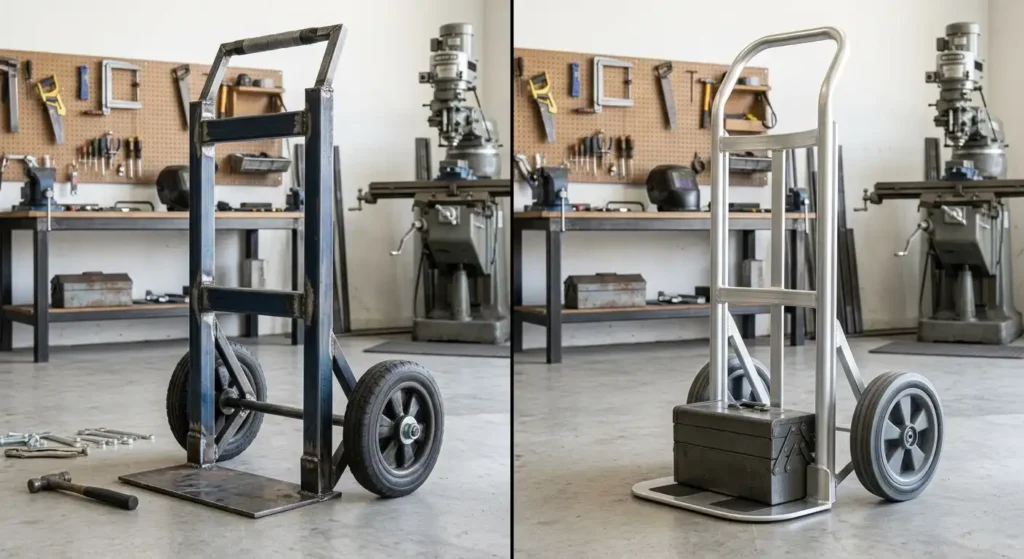
Homemade Hand Truck vs Store Bought Hand Truck
Before starting your build, weigh the trade-offs between making your own equipment and buying a manufactured unit:
| Factor | Homemade Hand Truck | Commercial Hand Truck |
| Initial Cost | Can be lower if you have scrap materials | Higher upfront purchase cost |
| Customization | High; sized to your exact height and needs | Fixed sizes and standard geometries |
| Construction | Depends entirely on your tools and skill | Factory built under consistent quality standards |
| Load Rating | Unrated; builder must test conservatively | Clearly rated and certified by manufacturer |
| Time Investment | Requires several hours to build and finish | Ready to work straight out of the box |
| Replacement Parts | Often requires custom workshop fabrication | Standard replacement parts readily available |
If you only need a specialized cart for light chores around your workshop, building one is a rewarding DIY project. But if you move heavy appliances, loaded toolboxes, or commercial freight regularly, a factory-built model is a smarter, safer investment. To see what features matter most when shopping, explore our hand truck buying guide and review our hand truck weight capacity guide.
Frequently Asked Questions
Yes, you can build a light-duty hand truck from dense hardwoods like oak or maple. Use through bolts and metal reinforcement brackets at joints. Never use weak softwood framing lumber, and inspect the wood regularly for cracks or loosening bolts before each use.
Steel square tubing and heavy structural angle iron provide the best strength and rigidity for a DIY frame. Steel parts allow strong welded or bolted joints. Aluminum tubing is lighter and resists corrosion, but requires advanced welding skills to assemble properly.
Flat-free solid polyurethane tires or pneumatic rubber wheels with a diameter of 8 to 10 inches work best for general utility carts. They roll easily over door thresholds, lawn edges, and concrete seams while providing cushioning for your cargo.
Building one is usually cheaper only if you already own suitable metal stock, wheels, hardware, and shop tools. If you must purchase raw steel, hardware, drill bits, and specialized wheels at retail prices, buying a basic commercial hand truck is often more economical.
No, standard bicycle wheels are not suitable for a hand truck. Bicycle wheels are built for radial loads supported from both sides of the hub. They bend easily when subjected to heavy side loads and tilting forces common to hand trucks.
Building your own hand truck dolly is a practical workshop project that helps you transport boxes and household supplies with less physical strain. The success of your build relies on selecting straight frame members, mounting a rigid axle, securing the wheels properly, and reinforcing high-stress joints.
Always put personal safety ahead of convenience. If you need to move heavy appliances, fragile cargo, or industrial equipment, choose a properly engineered, commercially rated hand truck instead.