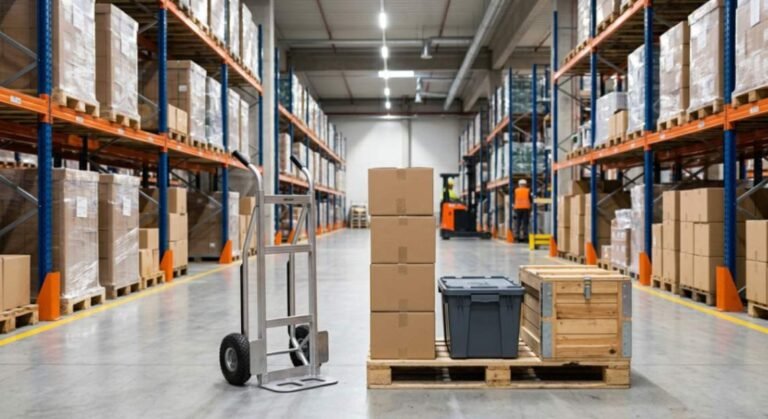

When you need to move heavy items, the terms “hand truck” and “dolly” are often used interchangeably. However, they are not the same type of equipment. Understanding the difference between a hand truck and a dolly is crucial for your safety, the protection of your cargo, and the efficiency of your job.
So, what is the exact difference?
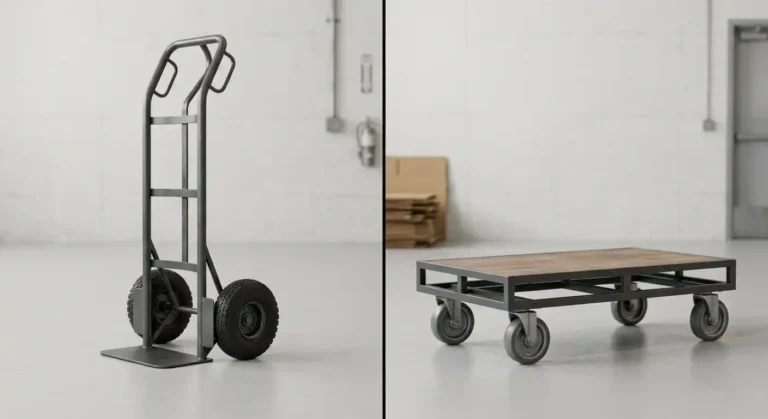
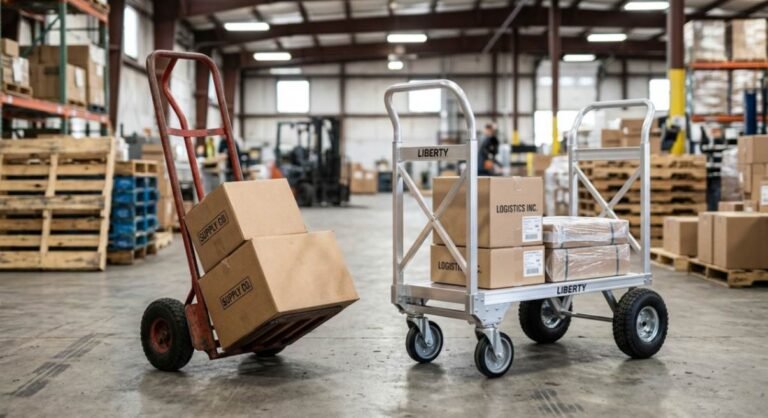
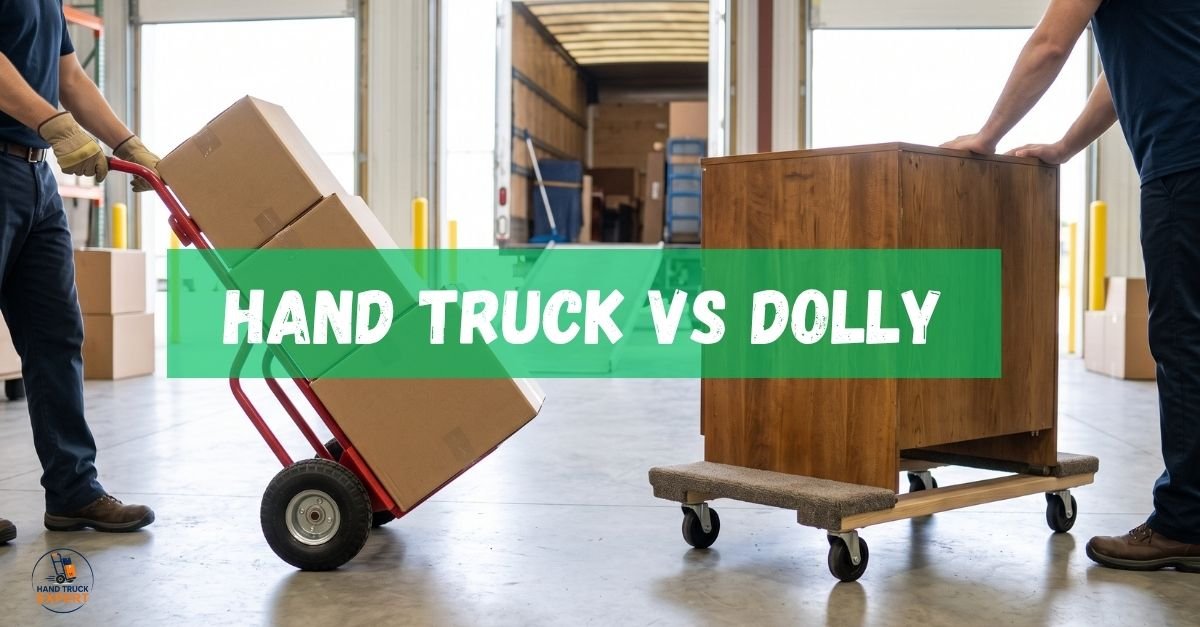
A traditional hand truck features an upright frame with two wheels and a bottom ledge (toe plate) designed to slide under a load, which is then tilted backward to move. A dolly, on the other hand, is a flat platform with four or more wheels (often casters) where the load rests horizontally directly on top.
The best choice depends entirely on your load’s shape, its center of gravity, your intended route, and the floor surface. A hand truck is generally better for upright, tall, or stacked loads like boxes, while a platform or furniture dolly is generally better for bulky, wide loads that can sit securely on a horizontal base.
Hand Truck vs Dolly: Quick Comparison
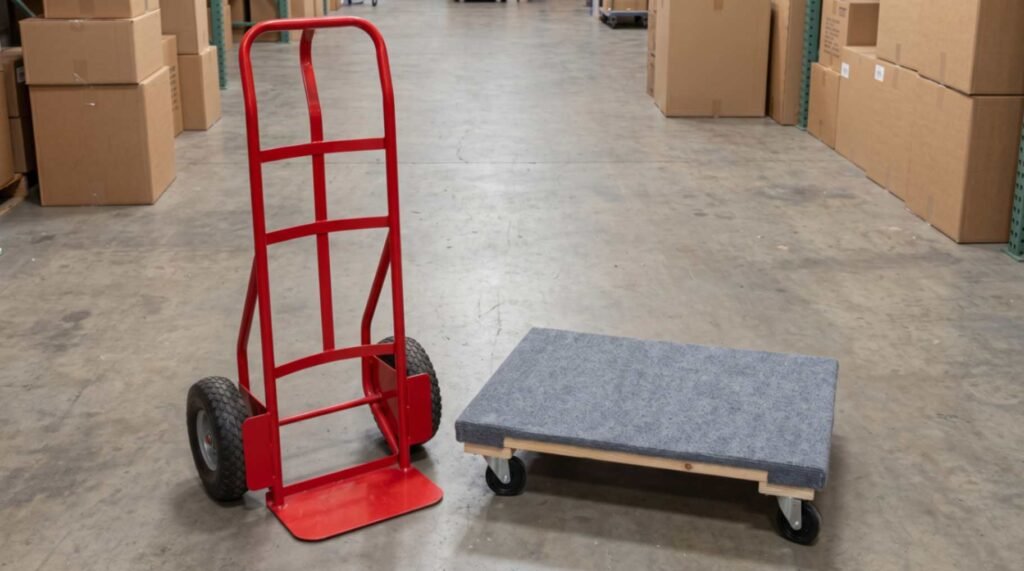
To make the right choice quickly, it helps to look at the core differences in design and application. While models vary significantly, the table below outlines the general differences between a standard two-wheel hand truck and a standard four-wheel platform dolly.
| Feature | Hand Truck | Dolly |
| Basic design | Upright L-shaped frame with handles | Flat platform with no tall frame |
| Typical wheel configuration | Two fixed wheels at the base | Four swivel casters (or fixed/swivel mix) |
| Typical load position | Tilted backward onto the wheels | Sitting flat and horizontally on the platform |
| Best uses | Stacked boxes, tall items, narrow routes | Bulky furniture, wide loads, heavy planters |
| Maneuverability | Excellent for tight turns and doorways | Can move in any direction (with swivel casters) |
| Stability | Requires the user to balance the tilted load | Inherently stable on flat floors |
| Stairs | Manageable, especially with specialized models | Not suitable for conventional stair use |
| Smooth floors | Good, but requires continuous balance | Excellent; load can be pushed with ease |
| Bulky loads | Limited by the width of the frame/toe plate | Ideal, provided the load fits the platform |
| Stacked loads | Excellent, assuming the load is secured | Prone to tipping if the stack is too tall |
| Storage | Takes up vertical space (unless folding) | Low profile; easily stored flat or against a wall |
| Load security | Often requires straps for tall items | Requires straps if the item is top-heavy |
The most significant difference comes down to leverage and balance. A hand truck uses leverage to lift a load off the ground, requiring you to maintain the load’s balance during transit. A dolly provides a stable, four-point base that carries the full weight independently, allowing you to simply push or pull.
What Is a Hand Truck?
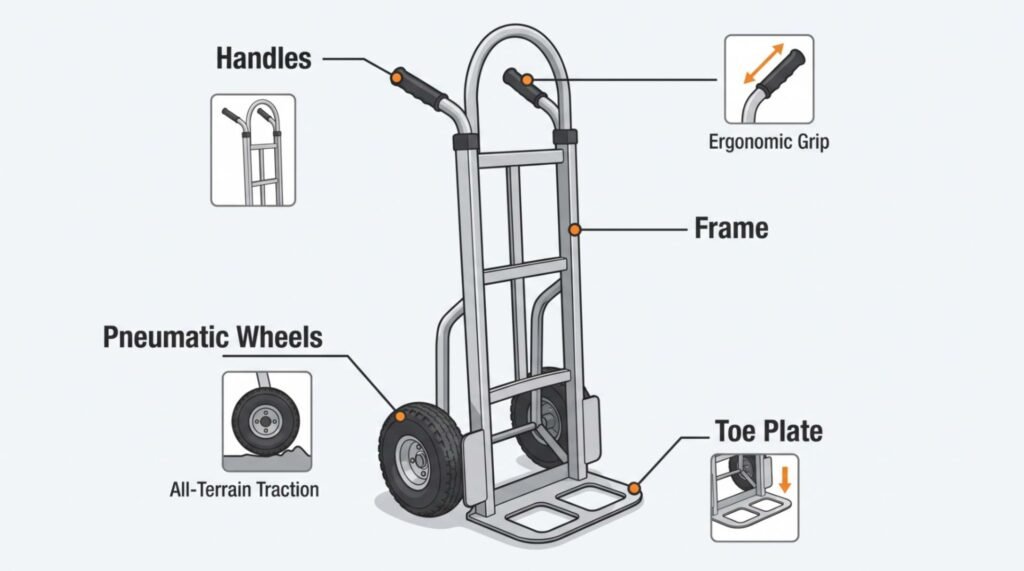
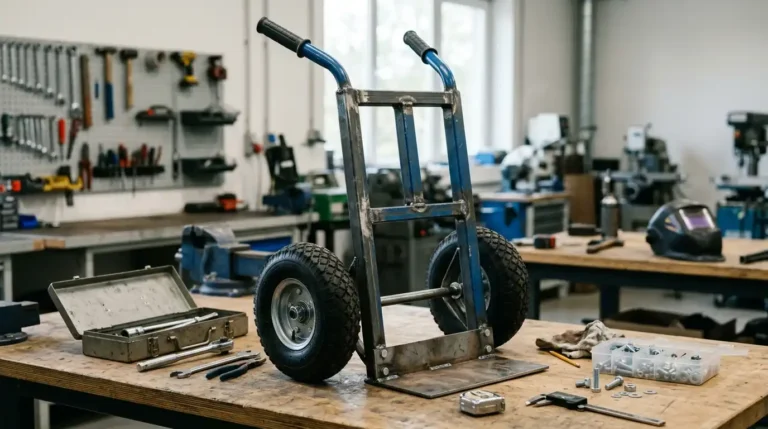
A hand truck is a piece of material-handling equipment characterized by its upright L-shaped design. It typically consists of a strong vertical frame, a set of handles at the top, two large wheels at the base, and a flat metal ledge at the bottom known as a toe plate or nose plate.
When using a hand truck, the load is positioned on the toe plate and leans against the vertical frame. The operator then tilts the entire frame backward toward their body. This action shifts the center of gravity over the two wheels, utilizing leverage to make heavy loads feel significantly lighter.
Because of its slim profile and maneuverability, a hand truck is commonly used by delivery drivers, warehouse workers, and individuals moving stacked boxes or tall appliances.
How Does a Hand Truck Work?
Operating a standard hand truck relies on simple physics.
- Position the toe plate squarely on the floor and slide it beneath your load.
- Ensure the load is resting flat against the vertical frame.
- Use safety straps to secure the item, especially if it is tall or awkwardly shaped.
- Place your foot gently against the axle or lower frame for leverage, pull back on the handles, and tilt the frame backward.
- Find the balance point where the load’s weight is centered over the wheels.
- Push or pull the hand truck carefully to your destination, maintaining that balance.
Always follow the manufacturer’s specific operating instructions, as proper tilting techniques can vary by model.
Common Types of Hand Trucks
While the basic design is universal, manufacturers have adapted hand trucks for different tasks:
- Standard hand trucks: Traditional two-wheel metal frames ideal for general-purpose moving.
- Heavy-duty hand trucks: Built with reinforced steel or thick aluminum to handle massive weight capacities.
- Folding hand trucks: Feature a collapsing handle and folding toe plate for easy storage in vehicle trunks or closets.
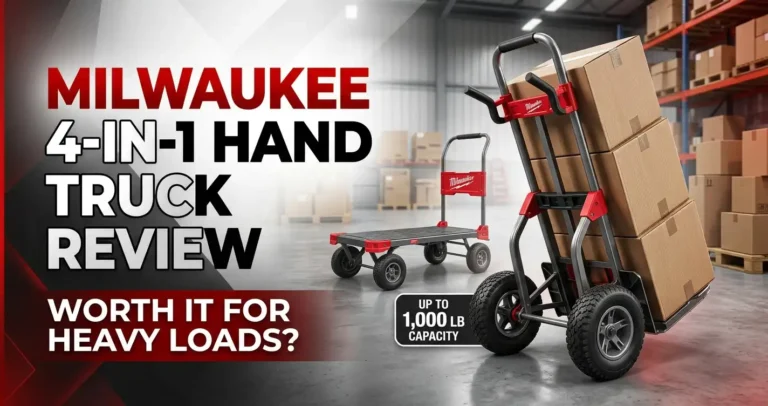
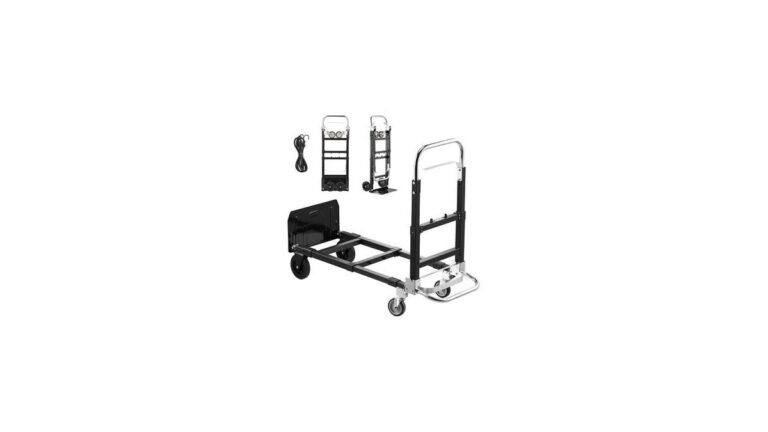
- Convertible hand trucks: Can transform from a standard two-wheel hand truck into a four-wheel platform cart.
- Appliance hand trucks: Specifically designed with specialized belts and dual-handle systems for moving refrigerators, washers, and dryers.
- Stair-climbing hand trucks: Equipped with a specialized tri-wheel or track system to navigate steps smoothly.
Read our detailed guide on the types of hand trucks available on the market today.
What Is a Dolly?
The word “dolly” is a broad term that describes several types of wheeled platforms used for moving heavy objects. Unlike a hand truck, a traditional dolly does not have an upright frame or a lifting ledge. It is simply a flat base equipped with wheels or casters.
The load is lifted manually (or with other equipment) and placed directly onto the platform. Because the load rests completely on a horizontal plane with four points of contact to the floor, the dolly supports the entire weight.
Dollies are incredibly popular for moving large, bulky, or wide objects that cannot be easily balanced on a two-wheel hand truck, such as pianos, large couches, and heavy machinery.
How Does a Dolly Work?
Using a dolly is straightforward, but it requires careful load placement.
- Safely lift the load using proper lifting techniques, team lifting, or lifting equipment.
- Center the platform dolly underneath the object.
- Lower the load onto the platform, ensuring the weight is distributed evenly across all four corners.
- Secure the item with straps if it is tall, unstable, or being moved over uneven ground.
- Push the load carefully. With swivel casters, you can easily guide the dolly in any direction.
- Constantly scan the floor for debris or cracks that could catch a caster.
Common Types of Dollies
Because the term is so broad, it is important to know the specific types available:
- Furniture dolly: A simple wooden or composite frame covered in carpet to protect wood finishes, usually featuring four swivel casters.
- Platform dolly: A solid flat deck (often steel or hard plastic) equipped with four wheels, ideal for warehouse environments.
- Moving dolly: A general term that usually refers to a solid deck dolly with a handle attached to one end for pushing.
- Appliance dolly: While sometimes used to describe a two-wheel appliance hand truck, it can also refer to interlocking specialized dollies placed under the feet of heavy appliances.
- Utility dolly: Specialized, heavy duty dollies built for industrial equipment or vehicle tires.
Hand Truck vs Dolly: What Are the Main Differences?
To decide which is better for your specific task, you must understand how their distinct characteristics impact load handling.
Design and Construction
The most obvious difference is the core structure. A hand truck relies on an upright frame and a protruding toe plate. This construction means the equipment does the “lifting” when you slide the plate under the load and tilt it back.
A dolly utilizes a flat platform design without a built-in lifting mechanism. You must lift the object onto the dolly first. The wheels also differ; hand trucks typically use two large, fixed wheels, while dollies frequently use four smaller swivel casters.
Load Position
Load position drastically alters how an item feels when you push it. On a hand truck, you are dealing with tilted, upright loads. You must maintain the balance point at an angle.
On a dolly, you are managing horizontal loads. The object sits flat, which requires zero effort to keep balanced once centered, but can be dangerous if the load is exceptionally top-heavy and encounters a bump.
Weight Capacity
Weight capacity is entirely model-specific. Never assume all hand trucks or all dollies can handle a certain weight. A heavy-duty steel hand truck might hold 1,000 pounds, while a cheap plastic dolly might buckle at 200 pounds and vice versa.
Always check the manufacturer’s rated capacity before using the equipment. Additionally, keep in mind that load dimensions matter just as much as weight, a load that is too wide may exceed the safe handling limits of a hand truck, even if it falls under the weight rating.
Maneuverability
Hand trucks excel in narrow spaces. Because you tilt the load, the overall footprint of the equipment and the load is quite slim. The two fixed wheels allow for sharp pivoting on a single axis, making tight corners and doorways highly manageable.
A platform dolly equipped with four swivel casters offers incredible 360-degree maneuverability in open spaces. However, in straight-line movement, all-swivel casters can sometimes “drift,” and wide loads on a dolly can easily become wedged in standard household doorways.
Stability
Stability depends on the center of gravity. A dolly provides a highly stable platform for wide, bulky items. Because the base is wide and sits flat, the load is naturally balanced.
A hand truck requires operator skill to maintain stability. If you tilt the load too far back or not far enough, the center of gravity shifts, and the load becomes difficult to control. Using straps is often essential to keep tall items secure against the hand truck’s frame.
Surface and Terrain
The wheels dictate where the equipment can travel. Hand trucks feature large pneumatic (air-filled) or solid rubber wheels. These larger diameters easily roll over uneven surfaces, thresholds, extension cords, and outdoor terrain like packed dirt or gravel.
Standard dollies usually feature small, hard casters designed for smooth floors, concrete, or low-pile carpet. Small casters will abruptly stop if they hit a threshold, a wide crack, or debris, potentially causing the load to tip.
Effort and Leverage
A hand truck uses leverage to reduce the physical effort required to lift an item off the floor. The axle acts as a fulcrum.
A dolly requires the user (or multiple people) to physically lift the total weight of the object to place it onto the platform. However, once loaded, a dolly requires significantly less effort to push across a smooth floor since you do not have to support any of the weight yourself.
Which Is Better: A Hand Truck or a Dolly?
There is no universal winner. The better choice depends entirely on what you are moving and where you are moving it.
Best for Moving Boxes
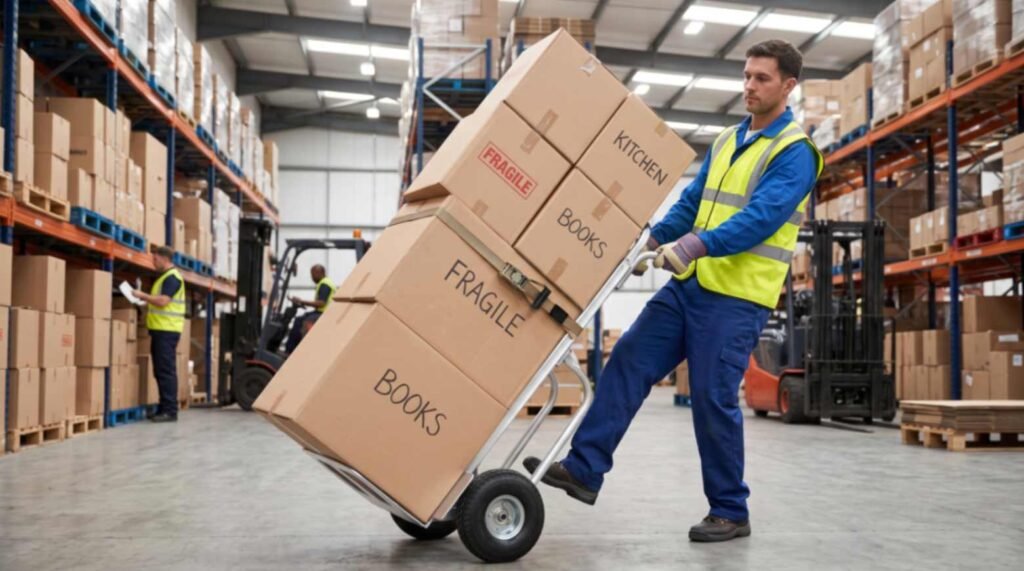
A hand truck is generally the best choice for stacked boxes. You can stack three or four moving boxes securely, slide the toe plate underneath, tilt, and go. The upright frame supports the stack, and you can easily navigate narrow hallways and doorways. Just remember to put the heaviest boxes on the bottom to maintain a low center of gravity.
Best for Moving Furniture
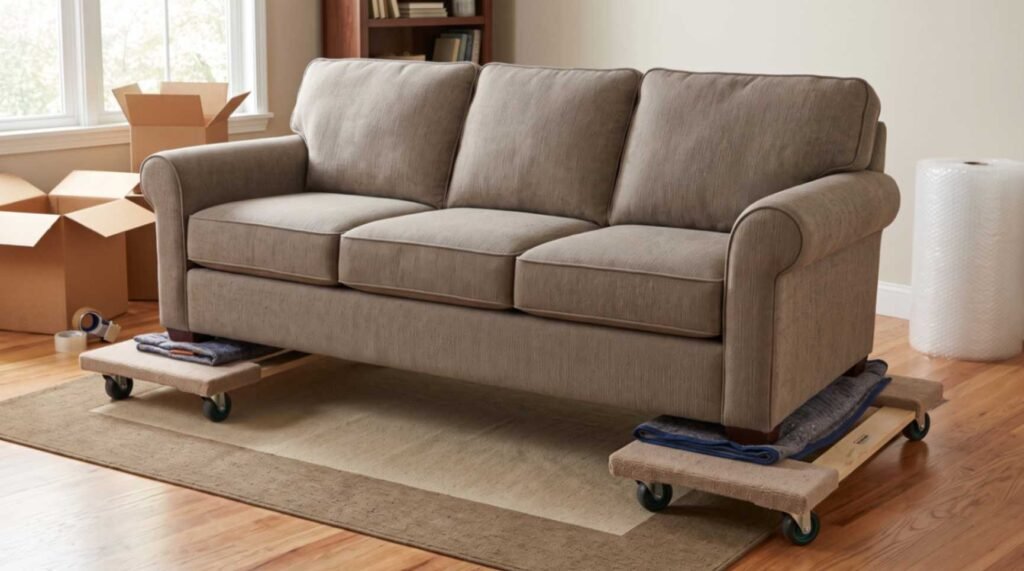
A furniture dolly or platform dolly is usually best for moving couches, dressers, cabinets, and heavy tables. These bulky objects are often too wide to balance safely on a narrow hand truck toe plate. A carpeted furniture dolly provides a soft, stable base that protects the furniture while supporting its wide frame on smooth floors.
Best for Moving Appliances
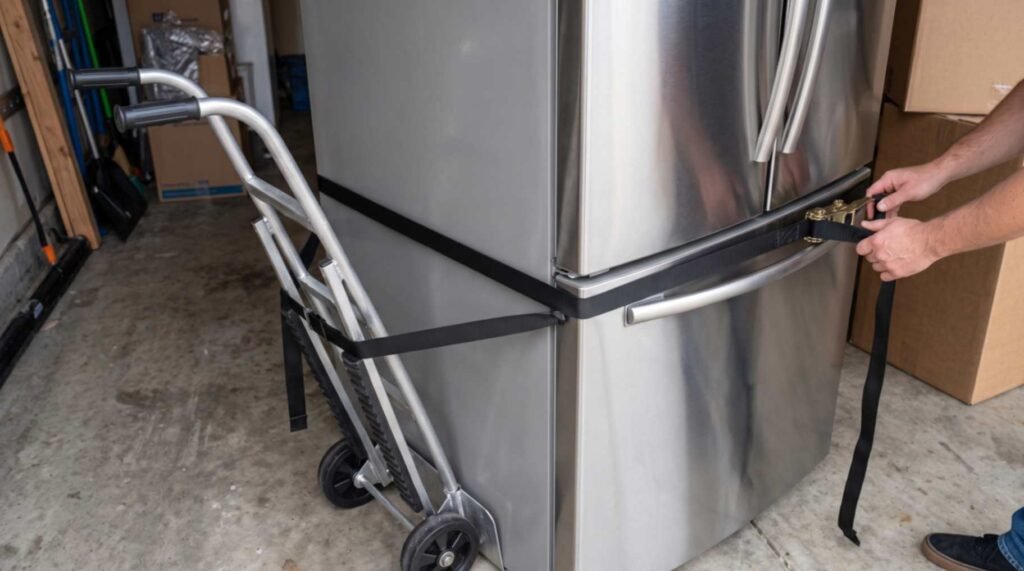
Moving refrigerators, washing machines, and ranges requires specialized equipment. An appliance hand truck is almost always the preferred choice. These specialized hand trucks feature built-in tension straps to secure the appliance to the frame, soft rubbing belts to protect stair edges, and dual handles for better grip. A standard dolly is generally unsafe for a tall refrigerator, as it can easily tip over.
Best for Moving Heavy Equipment
For heavy equipment like generators, industrial machinery, or safes, the choice is model-dependent. A heavy-duty convertible hand truck or a specialized heavy-duty platform dolly might be required.
The individual product’s rated capacity, wheel strength, and deck material matter far more than the general category of the equipment.
Best for Stairs
Hand trucks are the clear winner for stairs. Standard two-wheel hand trucks can be pulled up steps one at a time, though stair-climbing hand trucks with specialized tracks or rotating wheels make the job significantly easier.
Ordinary platform dollies with four casters are strictly for flat surfaces and are incredibly dangerous to use on stairs. Check our guide on how to use a hand truck on stairs.
Best for Narrow Spaces
A hand truck is generally superior in narrow spaces. Because the load is tilted and centered over two wheels, the overall width is usually limited only by the size of the box or appliance you are moving. Dollies with wide loads often struggle with standard household doorways.
Best for Flat Floors
If you are working in a warehouse, a gym, or an office with expansive, smooth floors, a platform dolly is incredibly convenient. You can load a tremendous amount of bulk onto the platform and easily push it long distances with minimal physical strain.
Hand Truck or Dolly? Choose Based on Your Job
If you are still wondering “hand truck vs dolly,” use this scenario-based guide to match the equipment to the task.
| Job | Usually Better Choice | Why |
| Moving stacked boxes | Hand truck | Upright frame supports tall stacks easily. |
| Moving a refrigerator | Appliance-specific equipment | Built-in straps and stair-belts safely handle tall, heavy loads. |
| Moving a sofa | Furniture dolly | Wide, flat base provides stability for long, awkward furniture. |
| Moving cabinets | Depends on design | Tall cabinets may need a hand truck; wide, low cabinets fit a dolly. |
| Moving heavy equipment | Model-dependent | Requires checking specific weight capacities and dimensions. |
| Moving across smooth floors | Dolly may be convenient | Four casters allow effortless pushing with zero balancing required. |
| Moving over thresholds | Model-dependent | Large hand truck wheels roll over bumps better than small dolly casters. |
| Moving on stairs | Specialized equipment | Stair-climbing hand trucks are required; standard dollies cannot do this. |
Always assess the route before you begin. You might load a sofa perfectly onto a furniture dolly, only to realize you have to cross a grassy yard where small casters will instantly sink into the dirt.
Hand Truck and Dolly Safety Tips
Regardless of which tool you choose, moving heavy objects carries a risk of injury or property damage. Follow these safety tips.
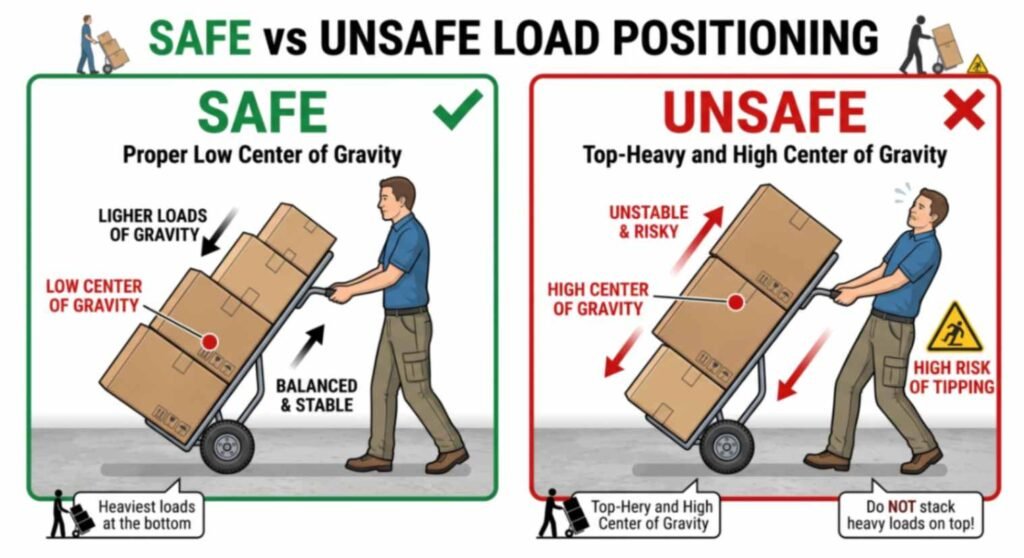
Check the Weight Capacity
Never guess how much a piece of equipment can hold. Always verify the manufacturer’s rated capacity. Overloading a hand truck can cause the axle to bend or the tires to pop, while overloading a dolly can shatter the casters mid-move.
Secure Unstable Loads
Always use ratchet straps, bungee cords, or built-in belts to secure unstable loads. This is especially vital for tall loads, appliances, stacked boxes, and items with an uneven center of gravity. A sudden stop can send an unsecured load flying forward.
Keep Your View Clear
Overloaded or excessively tall loads can obstruct your visibility. If you cannot see over the top of the boxes on your hand truck, you cannot see stairs, drop-offs, or obstacles in your path. Either reduce the stack height or pull the hand truck behind you so you have a clear line of sight.
Watch Ramps, Thresholds, and Slopes
Sudden changes in terrain affect stability immediately. Pushing a heavily loaded dolly across a sloped driveway can cause it to roll away from you. Hitting a threshold with small casters can bring the load to a violent halt. Navigate terrain changes slowly and methodically.
Inspect Wheels and Hardware
Before every major job, inspect your equipment. Check the air pressure in pneumatic tires. Ensure casters swivel freely. Look for loose fasteners on the frame, check the welds on the toe plate, and inspect your safety straps for fraying.
Don’t Exceed Your Ability
Equipment capacity does not automatically mean a single person can safely move the load. A hand truck might be rated for 800 pounds, but balancing and controlling 800 pounds requires immense physical strength. Follow manufacturer instructions and recruit a partner for difficult loads.
What to Look for When Choosing a Hand Truck or Dolly
If you are ready to purchase a hand truck or dolly, use this buying guide to evaluate the specifications that matter most.
Weight Capacity
Evaluate the rated capacity against your actual needs. If you only move household boxes occasionally, a 300-pound capacity is plenty. If you are handling engine blocks or massive gun safes, look for heavy-duty models rated for 800 to 1,000+ pounds.
Wheel Size and Material
Wheel design dictates performance. Large 10-inch pneumatic wheels offer a cushioned ride and easily roll over gravel and grass. Solid polyurethane wheels never go flat but can be jarring on bumpy surfaces. For dollies, hard rubber casters are great for concrete, while non-marring casters protect indoor hardwood floors.
Platform or Toe Plate Size
The contact area affects load stability. A hand truck with an extended toe plate provides much better support for deep, oversized boxes. A larger dolly platform accommodates wider furniture but can be harder to store.
Frame Material
Consider the construction material. Steel frames are incredibly durable and highly resistant to bending, making them ideal for heavy industrial use, but they are heavy. Aluminum frames are lightweight, rust-proof, and favored by delivery drivers who lift the equipment in and out of trucks all day.
Straps and Load Security
Look for equipment with built-in load security. Appliance hand trucks often feature integrated tension belts. Some high-end platform carts feature tie-down anchor points. If your chosen model lacks these, ensure you purchase separate high-quality ratchet straps.
Foldability and Storage
If space is limited, consider folding designs. Many aluminum hand trucks feature handles that telescope downward and toe plates that fold flat against the frame, allowing them to slide under a bed or into a compact car trunk.
Wheel Configuration
For dollies, pay attention to the casters. Four swivel casters offer maximum maneuverability in tight spaces. A configuration with two fixed casters and two swivel casters (common on push carts) provides better control for moving in straight lines down long hallways.
Intended Environment
Match the equipment to the environment. Will you be navigating stairs, rolling across rough outdoor surfaces, or simply pushing items across a smooth warehouse floor? Your environment should heavily influence whether you buy a rugged two-wheel hand truck or a flat four-wheel dolly.
Hand Truck vs Dolly: Pros and Cons
To summarize, here is a breakdown of the advantages and disadvantages of each.
Hand Truck Pros
- Excellent leverage makes heavy loads easier to lift.
- Highly useful for upright loads and stacked boxes.
- Narrow profile fits through standard doorways easily.
- Large wheels handle uneven terrain and thresholds well.
- Specialized models are available for stairs and appliances.
Hand Truck Cons
- Load balance requires physical effort and skill.
- Small toe plate size can limit compatibility with bulky furniture.
- Tall loads require careful control and strapping.
- Maximum weight capacity can vary drastically by model.
Dolly Pros
- Provides a stable, horizontal platform.
- Requires zero balancing once the load is centered.
- Excellent for moving long, wide, or bulky objects.
- Highly maneuverable on smooth, flat floors.
- Reduces physical strain during horizontal transit.
Dolly Cons
- Standard models are generally unsuitable and unsafe for stairs.
- User must physically lift the object onto the platform first.
- Small casters struggle with cords, cracks, and thresholds.
- Wide loads on a dolly can get stuck in narrow hallways.
So, Should You Buy a Hand Truck or a Dolly?
Ultimately, the choice between a hand truck and a dolly comes down to your primary use case.
Choose a standard or folding hand truck if you regularly move stacked boxes, tall appliances, or need the leverage to lift heavy items off the floor. They are superior for navigating narrow spaces, thresholds, and uneven terrain.
Choose a platform or furniture dolly if you frequently move bulky furniture, wide loads, or heavy planters, and your work takes place mostly on smooth, flat surfaces where the load can safely sit horizontal.
If your work involves many different types of loads, consider investing in a convertible hand truck that transforms from a two-wheel upright configuration into a four-wheel flatbed, giving you the best of both worlds.
Frequently Asked Questions
No. A hand truck features an upright L-shaped frame with two wheels and a lifting toe plate. A dolly is a flat horizontal platform, typically with four wheels or casters, designed to have the load sit completely flat on top of it.
The primary difference is design and load position. A hand truck slides under a load and tilts backward, utilizing leverage to balance the weight over two wheels. A dolly sits flat on the floor, supporting the total weight on four wheels without needing to be tilted.
Weight capacity varies drastically by model. Lightweight folding models may hold 150 pounds, while heavy-duty industrial steel hand trucks can carry up to 1,000 pounds or more. Always check the manufacturer’s specific rating.
Like hand trucks, dolly capacity is model-dependent. A basic wooden furniture dolly might hold 300 to 1,000 pounds, whereas heavy-duty industrial machine dollies can be rated for several thousand pounds.
No. Standard platform and furniture dollies are not designed for conventional stair use. Attempting to maneuver a loaded four-wheel dolly on stairs is highly dangerous. You should use a specialized stair-climbing hand truck instead.
An appliance hand truck is the best tool for moving heavy appliances like washing machines and refrigerators. They provide the necessary leverage, load security straps, and narrow profile required to safely move appliances through doorways.
Yes, a furniture or platform dolly is usually better for bulky items like couches and dressers. The wide, flat base supports the large dimensions of the furniture better than the narrow toe plate of a hand truck.
Yes, but you should use a specialized appliance hand truck. These models feature built-in tension straps to secure the refrigerator and dual handles to provide the necessary control for such a tall, heavy item.
A hand truck is generally better for moving boxes. The upright frame allows you to securely stack multiple boxes vertically, lift them easily using the toe plate, and navigate through narrow household doorways.
A hand truck can move tall, narrow furniture like filing cabinets or narrow bookshelves. However, it is generally not recommended for wide, bulky furniture like sofas or large dining tables, as the load will not balance safely on a narrow toe plate.